Black holes explained simply
A black hole is a region of space where gravity is so strong that not even light escapes. They exist as remnants of giant stars and as giants at the centres of galaxies, including our Milky Way.
How does a black hole form?
Stars stay in balance through the fire in their core. When the fuel runs out, the core collapses. In very massive stars gravity is so strong in the end that the core becomes a black hole. Such “stellar” black holes have a few to a few dozen solar masses.
The giants are quite different: “supermassive” black holes with millions to billions of solar masses sit at the centre of almost every large galaxy. The one in M87 weighs about 6.5 billion Suns.
The event horizon: the border of no return
The boundary beyond which nothing returns is called the event horizon. Its radius depends only on the mass: if the Sun were squeezed into a black hole, the radius would be only about 3 km, for the Earth barely 9 millimetres. The Sun will never become a black hole, though, as it does not have enough mass.
The photo of a black hole
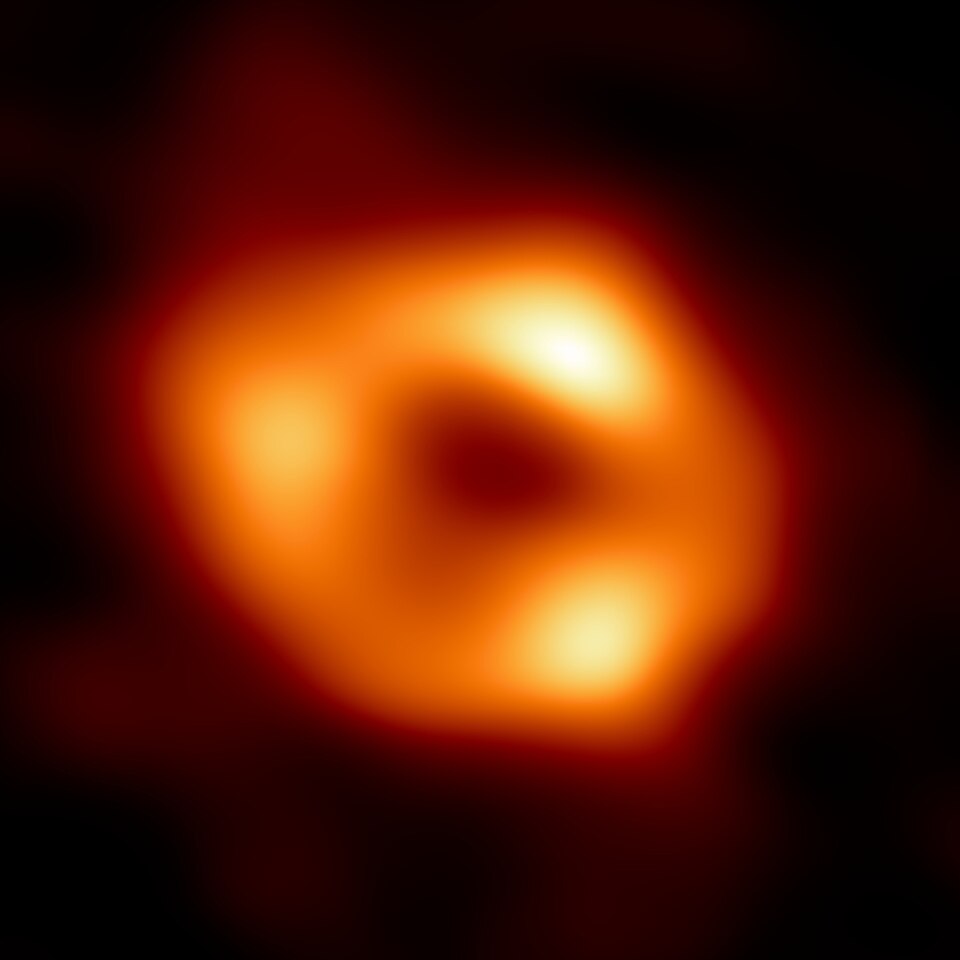
In 2019 the Event Horizon Telescope published the first image of a black hole, in the galaxy M87. In 2022 came the black hole at the centre of the Milky Way: Sagittarius A*. The image does not show the hole itself but its dark shadow within a ring of glowing gas. To make it, radio telescopes around the Earth were linked into one telescope.
- Mass
- 4.3 million Suns
- Distance
- 26,000 light-years
- Size (event horizon)
- about 25 million km – smaller than Mercury's orbit
More about Sagittarius A* in the fact file
How black holes are found
- Stars give them away: the star S2 orbits Sagittarius A* in just 16 years. Its orbit lets us calculate the mass. This earned Reinhard Genzel and Andrea Ghez the Nobel Prize in 2020.
- Gravitational waves: on 14 September 2015 the LIGO observatory measured gravitational waves for the first time. They came from two black holes of about 29 and 36 solar masses that merged roughly 1.3 billion years ago.
- Glowing gas: when matter falls into a black hole it heats up so much that it shines in X-rays and radio light.
Frequently asked questions about black holes
What is a black hole?
A black hole is a region of space where gravity is so strong that nothing can escape, not even light. You cannot see it directly, only its effect on stars and gas.
How does a black hole form?
A very massive star collapses at the end of its life and becomes a black hole. The giant black holes at the centres of galaxies have grown over billions of years.
Is there a black hole in our Milky Way?
Yes. At the centre of the Milky Way sits Sagittarius A*, with about 4.3 million solar masses, roughly 26,000 light-years from us.
Has a black hole ever been photographed?
Yes. The Event Horizon Telescope published the first image of a black hole (in the galaxy M87) in 2019 and the one of Sagittarius A* in 2022. What you see is glowing gas around the dark shadow.
Will the Sun become a black hole?
No. The Sun does not have enough mass. In a few billion years it will become a white dwarf.
Does a black hole suck everything in?
No. From a distance a black hole acts like any other body of the same mass. If you replaced the Sun with a black hole of the same mass, the planets would keep orbiting unchanged.
Read on
- Sagittarius A*: the black hole at the centre of the Milky Way
- The Milky Way
- The universe in five levels
- Astronomy glossary
▶ See Sagittarius A* in the 3D model
Books on this topic
Advertisement As an Amazon Associate I earn from qualifying purchases.
This site is free and has no banner ads. Here is how you can support it