Home › Universe › The Milky Way
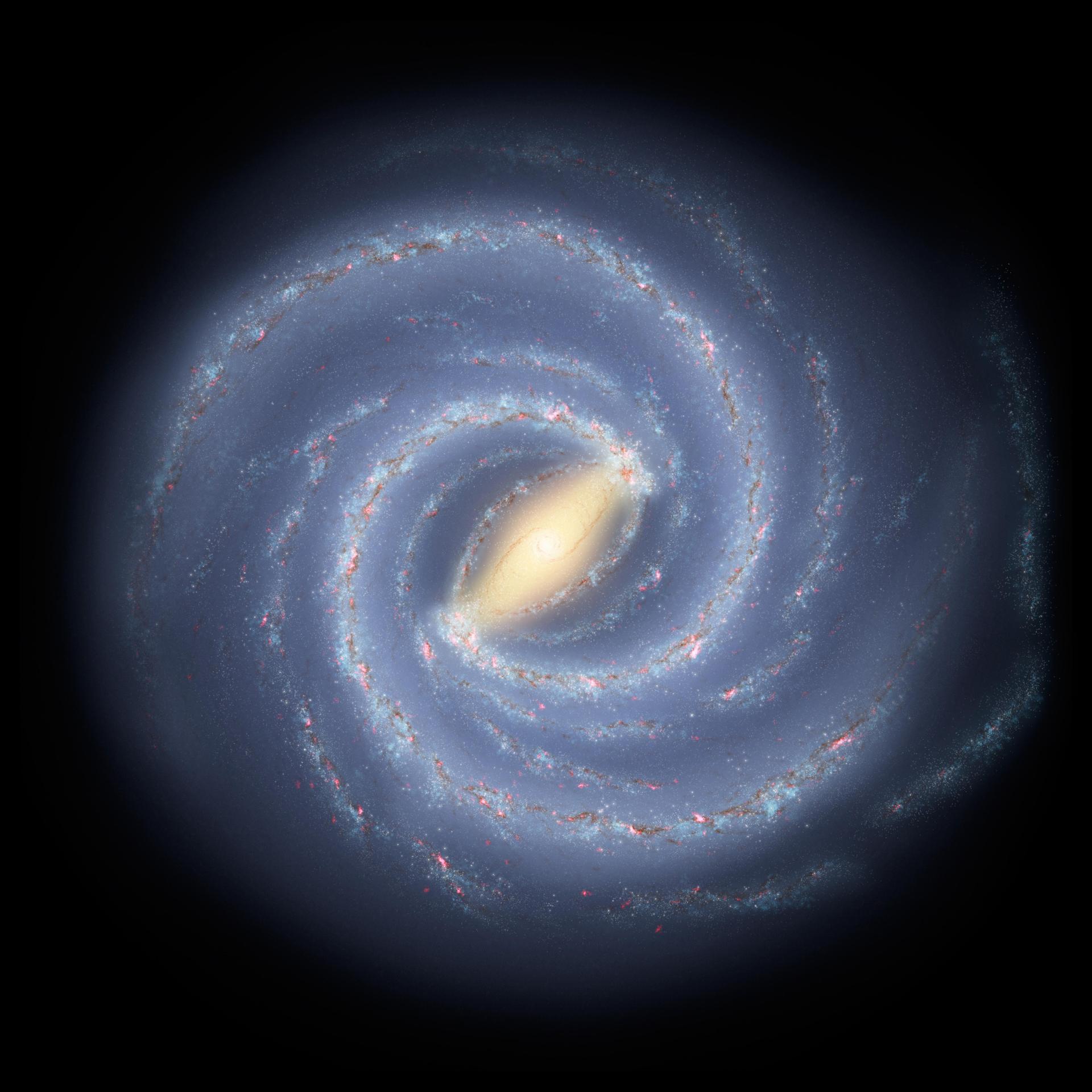
Illustration based on measured data
Barred spiral galaxy – our home galaxy
The Milky Way
Our home galaxy, with 100 to 400 billion stars. Seen from here it is a spiral like many others. The Sun lies about halfway between the centre and the edge.
Key figures
- Diameter
- about 100,000 light-years
- Thickness of the disc
- about 1,000 light-years
- Stars
- 100 to 400 billion
- Mass
- about 1.5 trillion Suns (including dark matter)
- Age
- over 13 billion years
- Sun from the centre
- 26,000 light-years
- One lap of the Sun
- about 230 million years
- Globular clusters
- about 150
Interesting facts
- The name comes from a Greek myth: the goddess Hera is said to have spilt milk. The Greek word for milk is “gala” – hence the word “galaxy”.
- We see the Milky Way from the inside – like a forest you are standing in. That is why it looks to us like a bright band right across the sky.
- Nobody has ever photographed the Milky Way from outside. Every picture from above is a drawing based on measurements – no probe has ever travelled that far.
- About 85% of its mass is invisible dark matter. Without it the Milky Way would fly apart, it spins so fast.
Structure
In the middle lies an elongated bar of old, yellowish stars (the “bulge”). Around it turns a flat disc with spiral arms full of young, blue stars, gas and dust – this is where new stars are born, the pink glowing nebulae. Surrounding everything is a spherical halo with ancient globular clusters and a great deal of dark matter.
Formation
The Milky Way began over 13 billion years ago as a cloud of gas. Since then it has grown by swallowing smaller galaxies – about 10 billion years ago, for example, the galaxy “Gaia-Enceladus”. Right now it is swallowing the Sagittarius Dwarf Galaxy.
Exploration
In 1610 Galileo Galilei saw through his telescope that the bright band is made up of countless individual stars. In 1918 Harlow Shapley showed that the Sun does not lie at the centre. Today the European satellite Gaia is measuring the positions of almost 2 billion stars – the most accurate map of our galaxy.
From Switzerland
From a dark place – in the mountains, for example, far from street lamps – you can see the Milky Way in summer as a shimmering band from the south (the constellation Sagittarius, towards the centre) to high overhead in Cygnus.
Future
The Andromeda Galaxy is coming closer. For a long time a collision in about 4.5 billion years was considered certain; new measurements (2025) give it only about a 50:50 chance within the next 10 billion years. If it does happen, the stars will hardly ever hit one another – they are far too far apart for that. In the end a large elliptical galaxy would form, which some already call “Milkomeda”.
Where is it?
The Milky Way belongs to the “The Milky Way” level of the Cosmic Zoom (field of view about 130,000 light-years). Our galaxy: a spiral of 100 to 400 billion stars. The Sun lies in the Orion Arm, 26,000 light-years from the centre. All the neighbouring stars from the previous level are inside the tiny dot at “Sun”.
Books on this topic
Advertisement As an Amazon Associate I earn from qualifying purchases. All books
This site is free and has no banner ads. Here is how you can support it