Planet
Venus
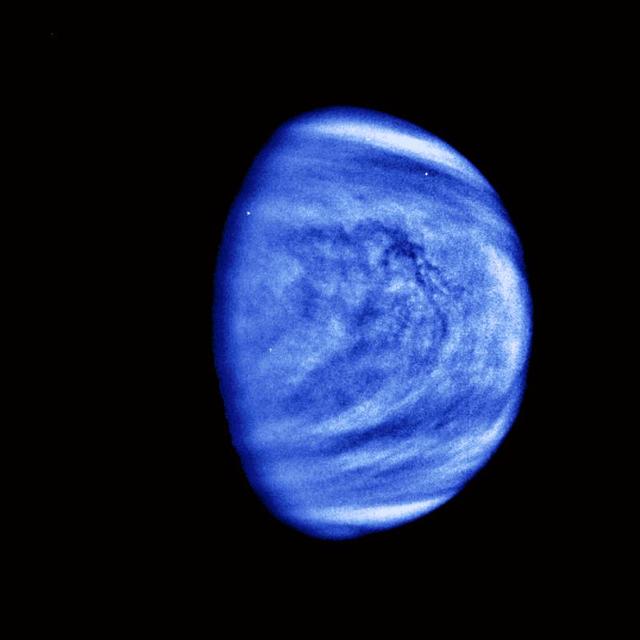
Venus is almost as big as Earth, but nobody would want to live there: thick clouds hold in the heat like a blanket – it is hotter than inside an oven. In the sky we see it as the bright “Evening Star”.
Fact file
- Type
- Planet
- Diameter
- 12,104 km
- Distance from the Sun
- 108,200,000 km
- Orbital period
- 224.7 days
- Shape of orbit (eccentricity)
- 0.007 (0 = circle)
- Orbital inclination
- 3.39° to Earth’s orbit
- Axial tilt
- 177.4°
- Temperature
- 464 °C on average
- Mass
- 0.815 Earth masses
- Gravity
- 0.9 times as strong as on Earth
- Escape velocity
- 10.4 km/s
- Length of day
- A solar day lasts 117 Earth days (it spins backwards)
- Number of moons
- 0
Interesting facts about Venus
- Venus is the hottest planet in the Solar System – even hotter than Mercury, because of an extreme greenhouse effect.
- Venus spins backwards (retrograde) and so slowly that its day is longer than its year.
- Thick clouds of sulphuric acid hide the surface completely.
Frequently asked questions about Venus
Why is Venus so hot?
The atmosphere of Venus is 96% carbon dioxide and extremely dense. This greenhouse effect traps the heat: at the surface it is about 464 °C. That makes Venus hotter than Mercury, even though it is farther from the Sun.
Why is Venus called the Evening Star and the Morning Star?
After the Sun and the Moon, Venus is the brightest object in the sky, because its clouds reflect a lot of sunlight and it comes very close to Earth. You see it either in the evening after sunset or in the morning before sunrise. But it is not a star, it is a planet.
Has a probe ever landed on Venus?
Yes. Soviet Venera probes landed on Venus in the 1970s and 1980s and sent back the only photos of its surface. Because of the heat and the pressure, which is 92 times as high as on Earth, they lasted about two hours at most.
How big is Venus?
Venus has a diameter of 12,104 km. That is about 95% of the diameter of Earth.
How far is Venus from the Sun?
Venus is on average 108.2 million km from the Sun. That is 0.72 astronomical units (AU). Sunlight takes about 6 minutes to cover this distance.
How long is a year on Venus?
Venus takes 224.7 days to travel once around the Sun.
How many moons does Venus have?
Venus has no moons.
How cold or warm is it on Venus?
On Venus the average temperature is 464 °C.
Name and discovery
After the Roman goddess of love – as the brightest planet in the sky, the “fairest”.
Visible to the naked eye – known since ancient times. As the “morning star” and the “evening star” it was once thought to be two different stars.
Formation
Like Earth, Venus formed from compacted rock, but massive volcanism gave it an extremely dense CO2 atmosphere.
Atmosphere
The atmosphere is 96% carbon dioxide, at a pressure 92 times that on Earth – comparable to being 900 metres under water.
Exploration
The Soviet Venera probes landed successfully in the 1970s and 80s and sent back the only photos from the surface of Venus. Japan's Akatsuki is currently studying the atmosphere.
Compared with Earth
Venus is often called Earth's “sister planet” because its size and mass are almost identical – yet conditions on the surface could hardly be more different.
Structure: what Venus looks like inside
- Iron core: About as big as Earth's core – but Venus has no magnetic field, probably because no currents arise in the core.
- Mantle: Hot rock that moves slowly. It feeds the many volcanoes.
- Crust: Around 30-50 km thick and only about 500 million years old – lava has renewed the whole surface.
- Atmosphere: An extremely dense CO₂ atmosphere: 90 times the pressure on Earth, with clouds of sulphuric acid.
In reality the crust is wafer-thin – it is drawn thicker so that you can see it.
The surface: 16 places on Venus
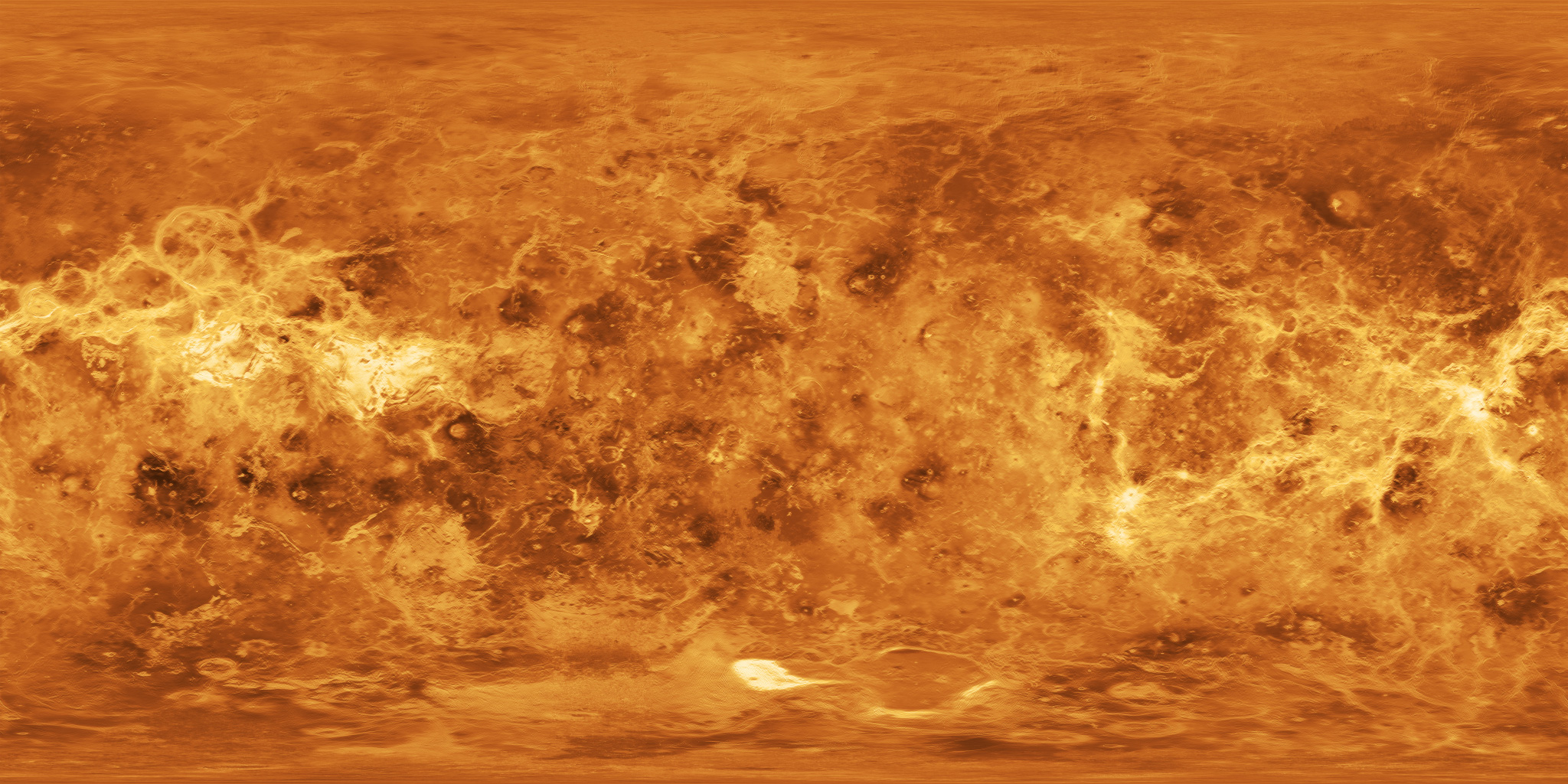
Venus is shrouded in thick clouds – this map was made from radar measurements by the Magellan probe (1990-1994) and has been colourised.
Mountains and volcanoes
- Maxwell Montes
- The highest mountain range on Venus, around 11 km high. The only major feature on Venus with a man's name (James Clerk Maxwell) – all the others are named after women or goddesses.
- Theia Mons
- A huge shield volcano in Beta Regio.
- Maat Mons
- The highest volcano on Venus (around 8 km). In 2023 researchers found a vent in old Magellan data that had changed within months – a sign of volcanism that is still active today.
- Sapas Mons
- A broad shield volcano (around 400 km in diameter) with two summits.
Regions
- Ishtar Terra
- One of the two “continents” of Venus, about the size of Australia.
- Aphrodite Terra
- The largest highland region on Venus, about the size of South America, running along the equator.
- Beta Regio
- A volcanic highland region, cut through by a large rift valley.
- Artemis Corona
- At around 2,100 km, the largest “corona” – a circular structure formed by hot rock rising from the interior.
- Lada Terra
- A highland region in the south of Venus.
- Baltis Vallis
- The longest known channel in the Solar System: around 6,800 km long, carved by very runny lava.
Seas and plains
- Lakshmi Planum
- A plateau around 4 km high, ringed by mountain ranges – similar to the Tibetan Plateau.
Craters
- Cleopatra
- An impact crater (105 km) on the flank of Maxwell Montes.
- Mead
- The largest impact crater on Venus (270 km). Venus has only around 1,000 craters in all – its surface was largely renewed by lava about 500 million years ago.
Landing sites
- Venera 7 – landing site
- 15 December 1970: the first probe to send data from the surface of another planet – for 23 minutes, at 475 °C.
- Venera 9 – landing site
- October 1975: the first photo from the surface of another planet.
- Venera 13 – landing site
- March 1982: the first colour photos from Venus. The probe withstood the pressure of 90 bar and the heat for 127 minutes.
In the 3D model you can click on these places on the map.
Space probes at Venus
Test your knowledge of Venus
Which planet is the hottest – even though it is not the closest to the Sun?
Venus. Venus's dense CO₂ atmosphere creates an extreme greenhouse effect: around 464 °C.
How long is a day on Venus (one rotation on its axis) compared with its year?
A day on Venus is longer than its year. Venus turns once in about 243 Earth days – its year lasts only about 225 Earth days. And it rotates backwards.
What is the name of the highest mountain range on Venus?
Maxwell Montes. About 11 km high – and the only major feature on Venus named after a man.
The full quiz with points and badges is in the 3D model under “Explore”.
Venus in the tours
This site is free and has no banner ads. Here is how you can support it