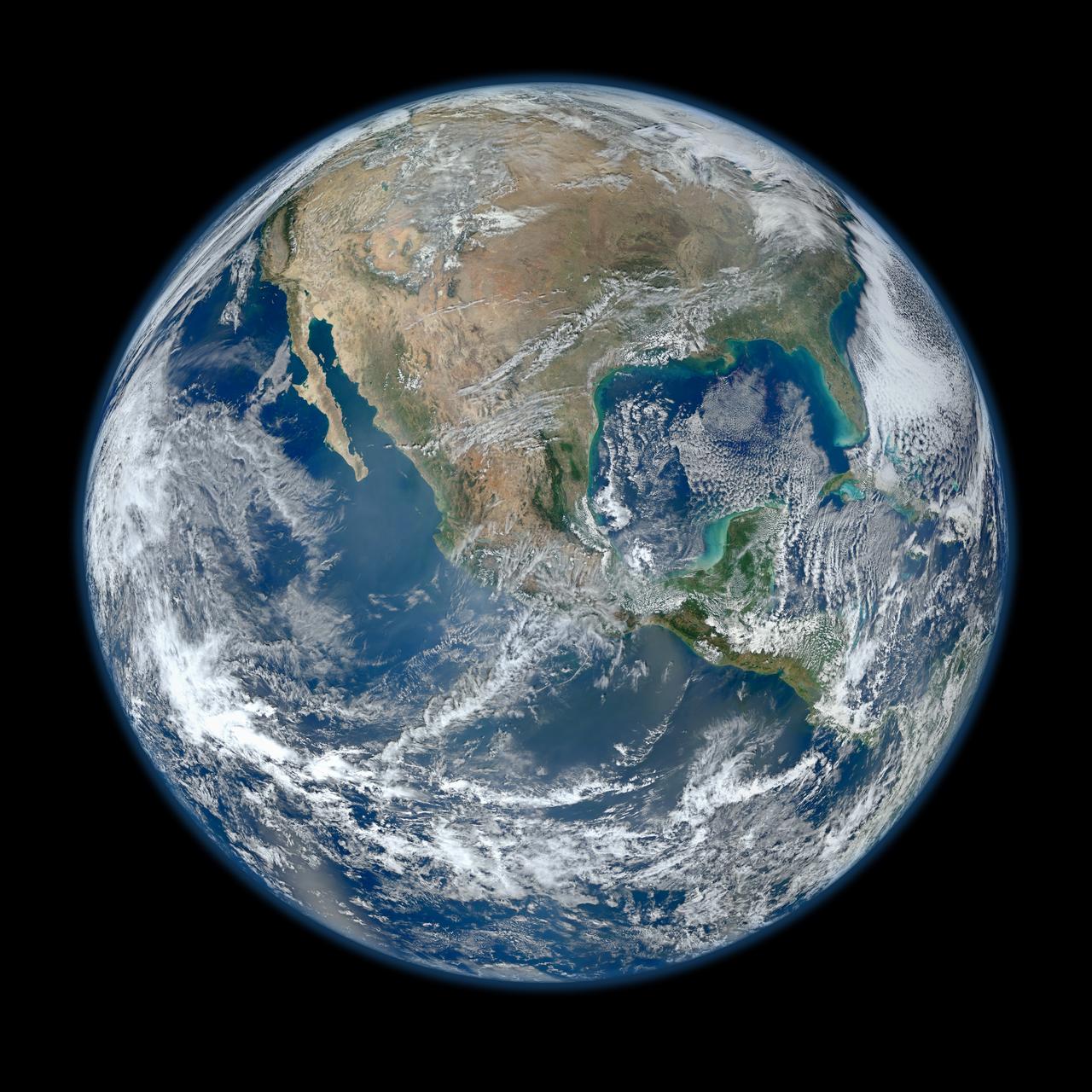
Planet
Earth
Earth is our home. It is the only planet where we know there is life. It is at just the right distance from the Sun: not too hot and not too cold – so there is liquid water.
Fact file
- Type
- Planet
- Diameter
- 12,742 km
- Distance from the Sun
- 149,600,000 km
- Orbital period
- 365.3 days
- Shape of orbit (eccentricity)
- 0.017 (0 = circle)
- Axial tilt
- 23.4°
- Temperature
- 15 °C on average (from -89 to 57 °C)
- Mass
- 1 Earth mass
- Gravity
- the same as on Earth
- Escape velocity
- 11.2 km/s
- Length of day
- 24 hours
- Number of moons
- 1
Interesting facts about Earth
- Earth is the only known place in the universe with confirmed life.
- 71% of Earth's surface is covered by water.
- Earth's magnetic field protects us from dangerous cosmic radiation.
Frequently asked questions about Earth
Why is there life on Earth?
Earth is at just the right distance from the Sun for water to stay liquid. It also has an atmosphere with oxygen and a magnetic field that shields it from dangerous radiation. Earth is the only known place in the universe with confirmed life.
Why do we have seasons?
Earth's axis is tilted by about 23.4°. As a result, over the course of the year first the northern hemisphere and then the southern hemisphere gets more sunlight. The seasons have nothing to do with the distance from the Sun.
How old is Earth?
Earth is about 4.54 billion years old. It formed from dust and rock that clumped together around the young Sun.
How big is Earth?
Earth has a diameter of 12,742 km.
How far is Earth from the Sun?
Earth is on average 149.6 million km from the Sun. That is 1 astronomical unit (AU). Sunlight takes about 8.3 minutes to cover this distance.
How long is a year on Earth?
Earth takes 365.3 days to travel once around the Sun.
How many moons does Earth have?
Earth has one moon.
How cold or warm is it on Earth?
On Earth the average temperature is 15 °C. The temperature ranges from −89 to 57 °C.
Name and discovery
From Germanic “ertho” = ground, soil. Earth is the only planet not named after a deity.
Formation
Earth formed about 4.54 billion years ago as dust and rock clumped together. Shortly afterwards, our Moon probably formed in a collision with a Mars-sized body (Theia).
Atmosphere
The atmosphere is 78% nitrogen and 21% oxygen – a rare mixture that was largely shaped by life (photosynthesis).
Exploration
Thousands of satellites orbit Earth for weather observation, communication and research; the International Space Station (ISS) has been continuously crewed since 2000.
Compared with Earth
Earth is our yardstick – all the other planets are usually described in comparison with it.
Structure: what Earth looks like inside
- Inner core: A solid ball of iron and nickel at around 5,400 °C – as hot as the surface of the Sun. The pressure keeps it solid all the same.
- Outer core: Liquid iron and nickel. Its currents generate Earth's magnetic field, which protects us from the solar wind.
- Lower mantle: Hot rock under immense pressure. Although solid, it flows extremely slowly – a few centimetres a year.
- Upper mantle: Here the mantle currents move the continental plates – and build mountain ranges such as the Alps.
- Crust: 30-70 km thick beneath the continents (up to 60 km beneath the Alps), only 5-10 km beneath the oceans – like the skin of an apple.
- Atmosphere: 78% nitrogen, 21% oxygen. Half of the air lies below an altitude of 5.5 km.
In reality the crust is wafer-thin – it is drawn thicker so that you can see it.
The surface: 26 places on Earth
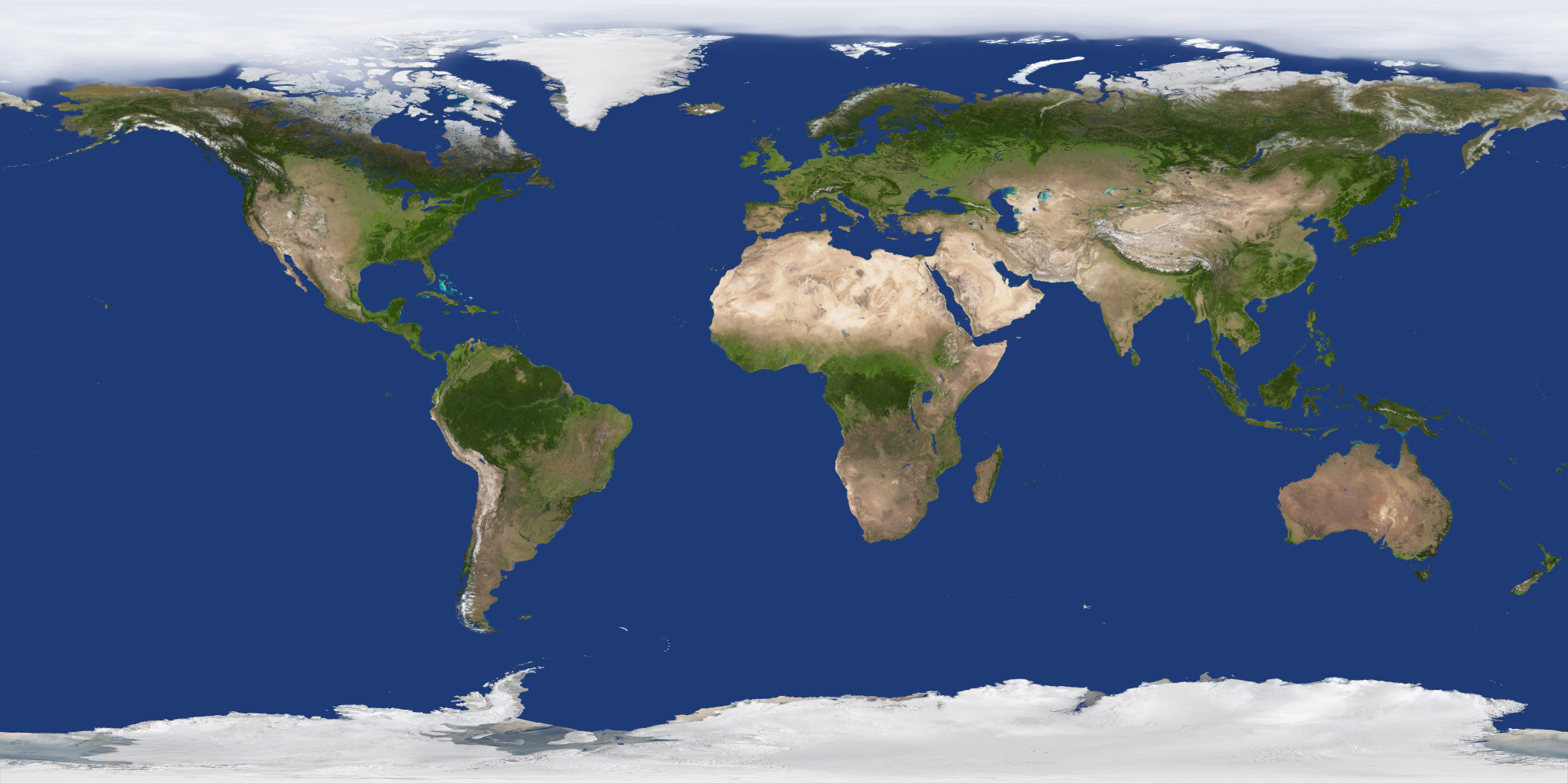
Cloud-free satellite mosaic (NASA Blue Marble).
Seas and plains
- Pacific Ocean
- The largest ocean: it covers around a third of Earth's surface – more than all the land areas put together.
- Atlantic Ocean
- The second-largest ocean. Down its middle runs the Mid-Atlantic Ridge, where Europe and America drift around 2.5 cm further apart every year.
- Indian Ocean
- The third-largest ocean and the warmest on Earth.
- Mediterranean Sea
- Around 5.6 million years ago it dried up almost completely, before the Atlantic burst back in at Gibraltar.
Regions
- Mariana Trench
- The deepest point in the oceans: around 10,900 m below sea level (Challenger Deep). Mount Everest would fit inside it.
- Sahara
- The largest hot desert on Earth, almost as big as the USA. 6,000 years ago it was still green, with lakes and savannahs.
- Amazon rainforest
- The largest rainforest on Earth, with an unimaginable variety of species – and an important store of carbon dioxide.
- Atacama Desert
- The driest non-polar desert on Earth. Because it is so similar to Mars, NASA tests Mars rovers here.
- Grand Canyon
- A gorge around 1.8 km deep, carved by the Colorado River over about 6 million years. Its rock walls reveal almost 2 billion years of Earth's history.
- Great Barrier Reef
- The largest coral reef on Earth (more than 2,300 km) – the largest structure built by living things, visible even from space.
- Dead Sea
- The lowest point on land (around 430 m below sea level). The water is so salty that you cannot sink in it.
- Greenland
- The largest island on Earth, around 80% of it covered by an ice sheet up to 3 km thick. If it melted completely, sea level would rise by around 7 m.
- Antarctica
- The coldest continent (record: -89.2 °C). Its ice holds around 70% of Earth's fresh water.
Mountains and volcanoes
- Mount Everest
- The highest mountain above sea level (8,849 m). For comparison: the Martian volcano Olympus Mons is almost three times as high.
- Matterhorn
- A 4,478 m peak on the border between Switzerland and Italy. The Alps formed because the African Plate is pushing against Europe – they are still growing today.
- Kilimanjaro
- The highest mountain in Africa (5,895 m), a dormant volcano with shrinking glaciers.
- Aconcagua
- The highest mountain in the Americas (6,961 m), in the Andes.
- Mauna Kea
- Measured from the sea floor, at around 10,200 m the tallest mountain on Earth. Some of the world's most important telescopes stand on its summit.
Craters
- Chicxulub crater
- A crater around 180 km across, hidden beneath the Yucatán Peninsula. The impact 66 million years ago triggered the extinction of the dinosaurs.
- Vredefort crater
- The largest confirmed impact crater on Earth (originally around 300 km), about 2 billion years old.
- Meteor Crater (Barringer)
- A superbly preserved crater around 1.2 km wide in Arizona, formed about 50,000 years ago. Apollo astronauts trained here.
- Nördlinger Ries
- A crater (24 km) in southern Germany, formed 14.8 million years ago. Apollo 14 and Apollo 17 astronauts practised geology here. Ejected rock from it can still be found in Switzerland too.
Landing sites
- Kennedy Space Center
- All the crewed Apollo flights to the Moon and the Space Shuttles lifted off from here – today the Artemis Moon rockets launch from here as well.
- Baikonur
- The oldest spaceport: Sputnik 1 was launched from here in 1957, and in 1961 Yuri Gagarin became the first human to fly into space.
- Kourou (Europe's Spaceport)
- The launch site of the European Space Agency ESA in French Guiana. Being close to the equator gives rockets an extra boost from Earth's rotation.
- Apollo 11 – splashdown
- On 24 July 1969 the capsule carrying Armstrong, Aldrin and Collins came down here in the Pacific after the first flight to land on the Moon.
In the 3D model you can click on these places on the map.
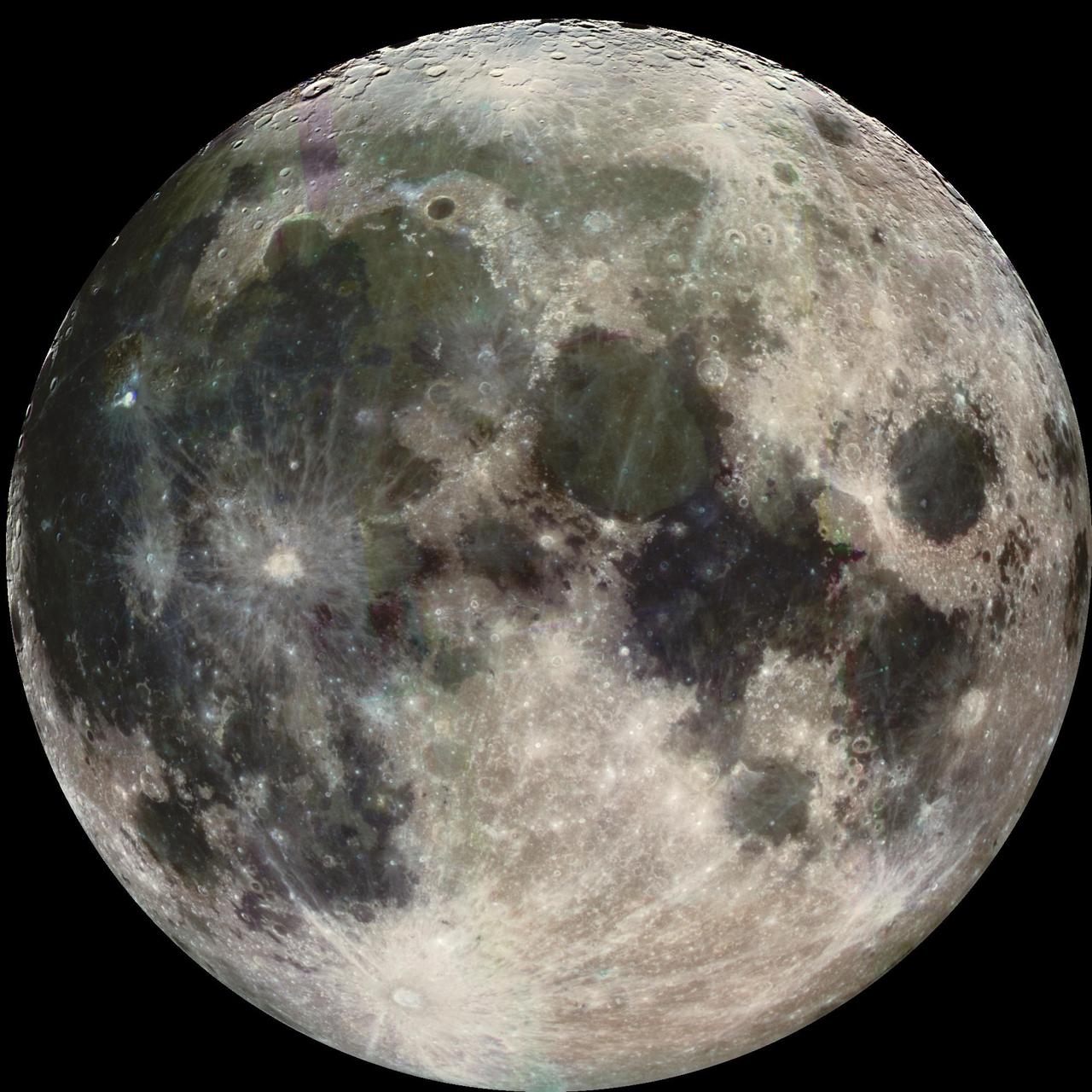
Moons of Earth
Test your knowledge of Earth
Roughly how far is Earth from the Sun (1 astronomical unit)?
150 million km. 384,000 km, by the way, is the distance to the Moon. 1 AU is the basis for all distances in the Solar System.
Who was the first person in space, in 1961?
Yuri Gagarin. On 12 April 1961 Gagarin circled Earth once – the flight lasted 108 minutes.
Which impact triggered the extinction of the dinosaurs 66 million years ago?
Chicxulub. The crater, about 180 km across, lies beneath Mexico's Yucatán Peninsula.
The full quiz with points and badges is in the 3D model under “Explore”.
Earth in the tours
This site is free and has no banner ads. Here is how you can support it