Planet
Mercury
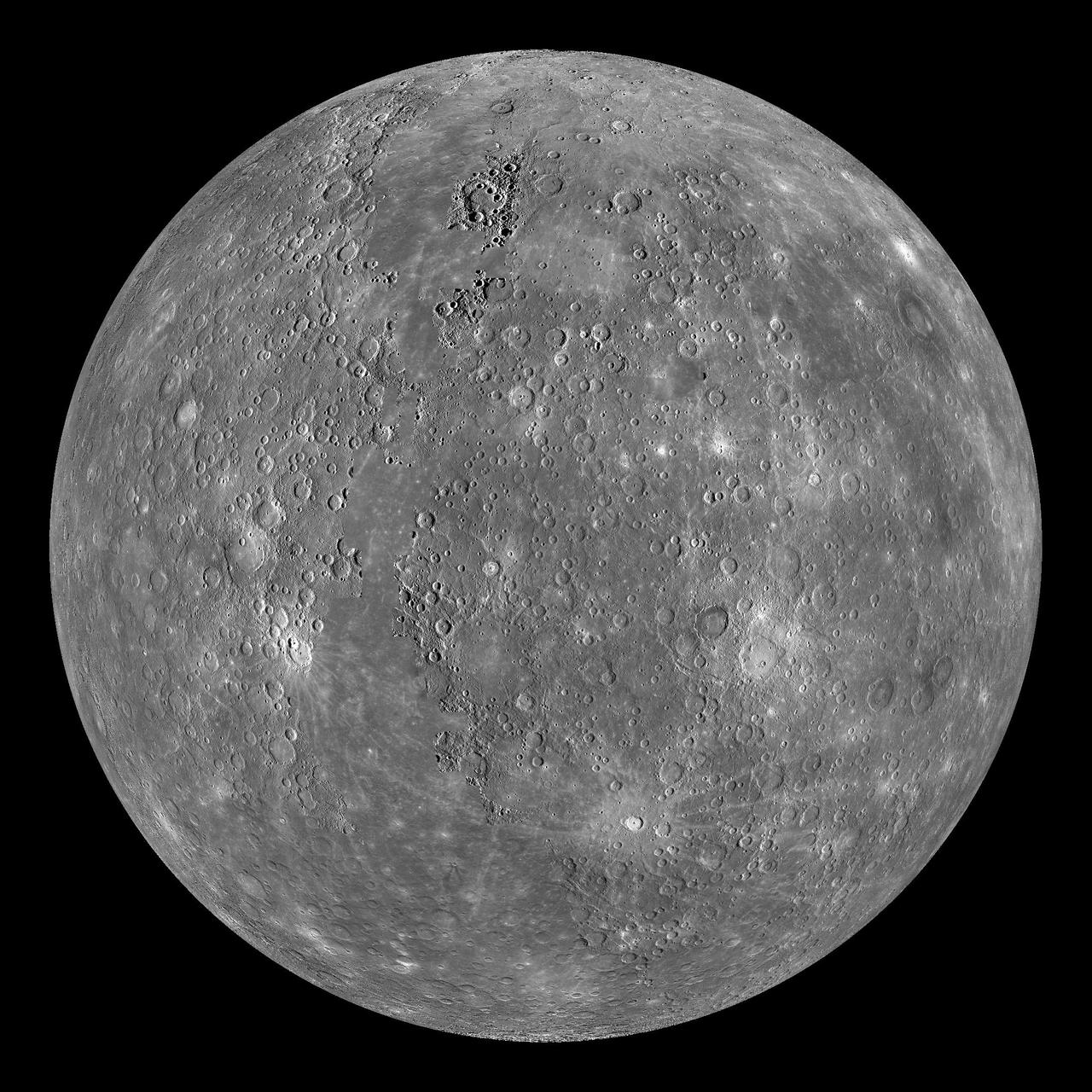
Mercury is the smallest planet and the closest to the Sun. It has no air. That is why it is scorching hot by day and icy cold at night. A year on Mercury lasts only 88 days.
Fact file
- Type
- Planet
- Diameter
- 4,879 km
- Distance from the Sun
- 57,900,000 km
- Orbital period
- 88 days
- Shape of orbit (eccentricity)
- 0.206 (0 = circle)
- Orbital inclination
- 7° to Earth’s orbit
- Axial tilt
- 0°
- Temperature
- 167 °C on average (from -180 to 430 °C)
- Mass
- 0.055 Earth masses
- Gravity
- 0.38 times as strong as on Earth
- Escape velocity
- 4.3 km/s
- Length of day
- A solar day lasts 176 Earth days
- Number of moons
- 0
Interesting facts about Mercury
- Mercury is the smallest planet in our Solar System and the closest to the Sun.
- A day (sunrise to sunrise) on Mercury lasts 176 Earth days – longer than its year!
- Although Mercury is so close to the Sun, there is water ice in permanently shadowed craters at its poles.
Frequently asked questions about Mercury
Why is Mercury not the hottest planet?
Mercury has almost no atmosphere to hold in heat. By day it gets as hot as 430 °C, and at night it cools to about −180 °C. Venus is hotter, at about 464 °C, because its dense atmosphere traps the heat.
Is there ice on Mercury?
Yes. In craters at the poles that sunlight never reaches there is water ice, even though Mercury is the planet closest to the Sun.
How long is a day on Mercury?
From one sunrise to the next, 176 Earth days pass on Mercury. That is twice as long as a Mercury year, which lasts only 88 days.
How big is Mercury?
Mercury has a diameter of 4,879 km. That is about 38% of the diameter of Earth.
How far is Mercury from the Sun?
Mercury is on average 57.9 million km from the Sun. That is 0.39 astronomical units (AU). Sunlight takes about 3.2 minutes to cover this distance.
How long is a year on Mercury?
Mercury takes 88 days to travel once around the Sun.
How many moons does Mercury have?
Mercury has no moons.
How cold or warm is it on Mercury?
On Mercury the average temperature is 167 °C. The temperature ranges from −180 to 430 °C.
Name and discovery
After Mercury, the fleet-footed messenger of the Roman gods – it is the fastest planet.
Visible to the naked eye – known since ancient times.
Formation
Mercury formed 4.5 billion years ago from rock and metal in the innermost, hottest part of the protoplanetary disc.
Atmosphere
Mercury has practically no atmosphere, only a wafer-thin “exosphere” of oxygen, sodium and hydrogen that is constantly blown away by the solar wind.
Exploration
NASA's MESSENGER probe orbited Mercury from 2011-2015. The European-Japanese mission BepiColombo is currently on its way there.
Compared with Earth
Mercury is only about 38% the size of Earth and has hardly any atmosphere – so the temperature differences between day and night are extreme.
Structure: what Mercury looks like inside
- Iron core: Huge: over 80% of the radius! An early impact probably tore away much of the rocky mantle. Parts of the core are liquid – Mercury has a weak magnetic field.
- Mantle: A comparatively thin layer of silicate rock, around 400 km thick.
- Crust: Around 35 km thick, full of craters and shrinkage wrinkles.
In reality the crust is wafer-thin – it is drawn thicker so that you can see it.
The surface: 16 places on Mercury
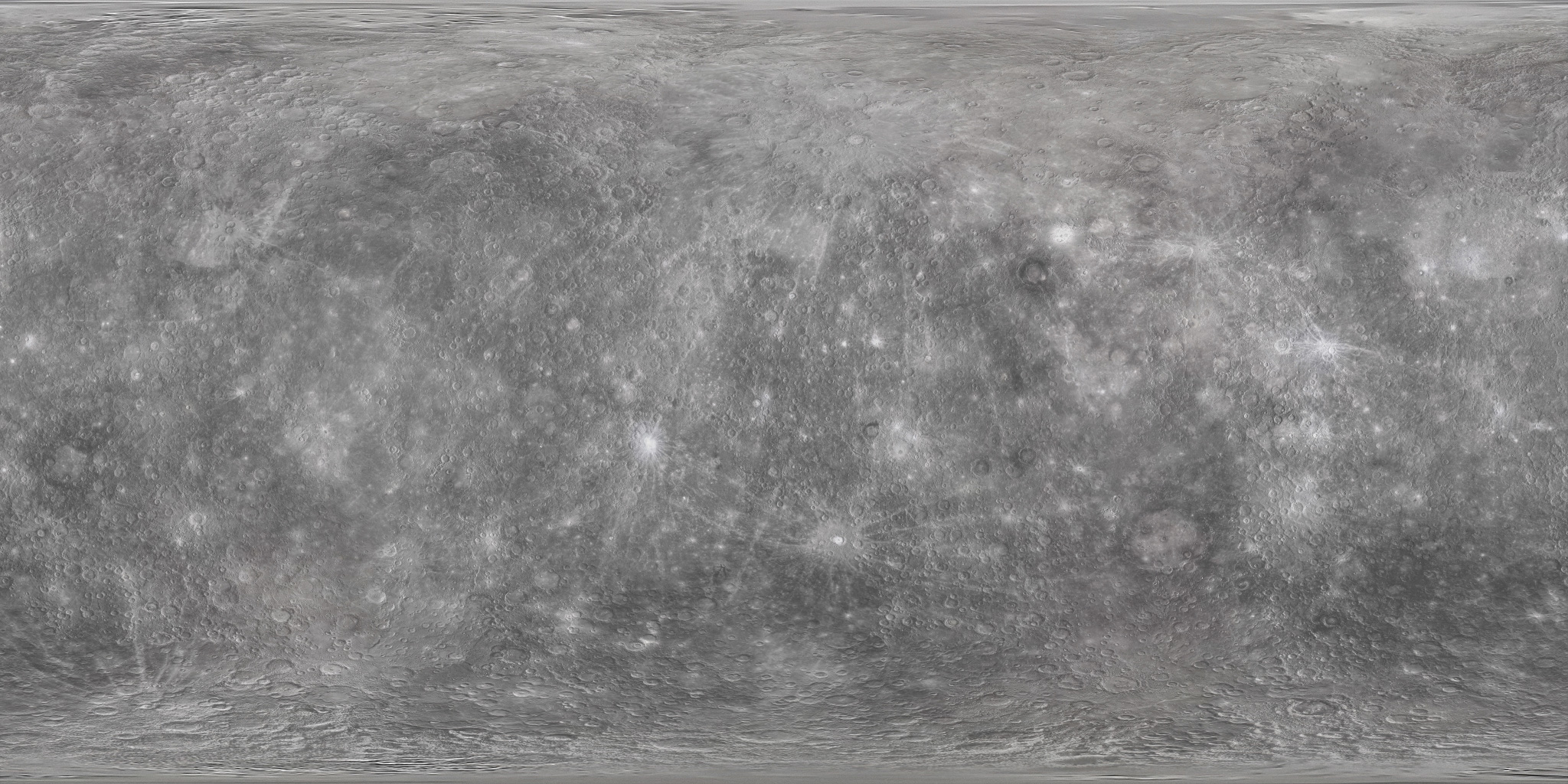
Craters
- Caloris Basin
- One of the largest impact basins in the Solar System (around 1,550 km). The impact was so violent that its shock waves shattered the terrain on the exact opposite side of the planet.
- Rembrandt
- Mercury's second-largest basin (715 km), discovered by MESSENGER only in 2008.
- Beethoven
- A large basin (630 km) with a lava-filled floor. Craters on Mercury are named after artists, musicians and writers.
- Rachmaninoff
- A double-ring basin (290 km) with a smooth floor of comparatively young lava – Mercury was volcanically active for longer than thought.
- Raditladi
- A double-ring crater (263 km); at “only” around a billion years old, it is one of the younger large craters.
- Tolstoj
- A very old basin (390 km), surrounded by dark ejecta.
- Kuiper
- A bright ray crater (62 km) – the first named feature on Mercury, after Gerard Kuiper, who also gave his name to the Kuiper Belt.
- Debussy
- A young crater (80 km) with brilliant rays that stretch for hundreds of kilometres.
- Hokusai
- A crater (114 km) with one of the longest ray systems on Mercury (more than 4,000 km).
- Bashō
- A crater (75 km) with a striking dark ring around a bright core.
- Prokofiev (north pole)
- A crater at the north pole whose floor is never lit by the Sun. Radar and MESSENGER data show water ice there – on the planet closest to the Sun!
- Chao Meng-Fu (south pole)
- A large crater (167 km) at the south pole, also with water ice in permanent shadow.
Regions
- Chaotic terrain (antipode of Caloris)
- Jumbled, hilly terrain exactly opposite the Caloris Basin – probably created by the shock waves of the Caloris impact travelling right round the planet.
- Discovery Rupes
- A scarp around 650 km long and up to 1.5 km high. Scarps like this formed when Mercury shrank as it cooled – like the skin of a shrivelling apple.
Seas and plains
- Borealis Planitia
- A vast, smooth lowland plain in the north – flooded by enormous lava flows.
Landing sites
- MESSENGER – impact
- On 30 April 2015 the MESSENGER probe crashed here after four years in orbit. The European-Japanese BepiColombo mission is due to continue the research from late 2026.
In the 3D model you can click on these places on the map.
Space probes at Mercury
Test your knowledge of Mercury
Which planet is closest to the Sun?
Mercury. Mercury orbits the Sun in just 88 days at an average distance of 58 million km.
The full quiz with points and badges is in the 3D model under “Explore”.
Mercury in the tours
This site is free and has no banner ads. Here is how you can support it