Home › Space probes › Voyager 1
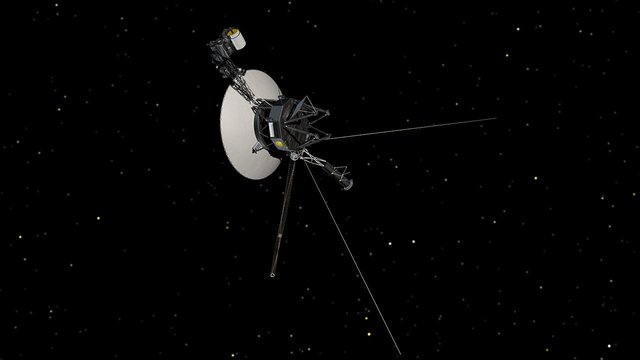
Artist's impression
Space probe
Voyager 1
Voyager 1 is a space probe that set off in 1977. It is the human-made thing that is furthest from Earth. On board it carries a golden record with greetings from Earth.
Fact file
- Type
- Space probe
- Launch
- 5 September 1977
Interesting facts about Voyager 1
- Voyager 1 is the most distant object ever built by humans. Around November 2026 it will be a whole “light-day” away from Earth.
- On board is the “Golden Record”: a gold-plated record with greetings in 55 languages, music and pictures of Earth – for any aliens who might find it.
- Its computer has about 69 kilobytes of memory – less than a single phone photo – and has been working for almost 50 years.
Frequently asked questions about Voyager 1
Where is Voyager 1 now?
Voyager 1 has been flying through interstellar space, outside the Sun's sphere of influence, since 25 August 2012. It is more than 25 billion km from Earth, which makes it the most distant object humans have ever built.
Is Voyager 1 still working?
Yes, as of 2026 it is still sending data to Earth. But its nuclear batteries grow weaker every year, so its instruments are being switched off one by one.
What is the Golden Record?
The Golden Record is a gold-plated phonograph record on board Voyager 1 and Voyager 2. It contains greetings in 55 languages, music and pictures of Earth, as a message for any extraterrestrials.
When was Voyager 1 launched?
The mission began on 5 September 1977.
Which celestial bodies has Voyager 1 visited?
Voyager 1 visited Jupiter and Saturn. All milestones with their dates are listed further down this page.
The mission
Built by NASA's Jet Propulsion Laboratory. The Voyager probes made use of a rare alignment of the planets that happens only once every 175 years.
Technology and flight
Power comes from radioisotope batteries (plutonium), which grow weaker every year. One by one, the instruments are being switched off.
Discoveries
Voyager 1 discovered the volcanoes on Io and flew close past Titan. That flung it out of the plane of the planets, so it could not visit any more planets.
For comparison
Its radio signals now have only the power of a fridge light bulb and take almost a day to reach Earth.
Mission milestones
- Launch at Earth
Launch on a Titan IIIE rocket from Cape Canaveral (Florida) – 16 days after Voyager 2, but on a faster path.
- Jupiter at Jupiter
Jupiter flyby: discovery of active volcanoes on Io and of a thin ring around Jupiter.
- Saturn & Titan at Saturn
Close flyby of Titan and Saturn. After that, Voyager 1 leaves the plane of the planets.
- “Pale Blue Dot”
From 6 billion km away, Voyager 1 photographs Earth as a tiny pale blue dot – one of the most famous photos of all time.
- Most distant object
Voyager 1 overtakes Pioneer 10 and becomes the most distant object ever built by humans.
- Interstellar space
Voyager 1 leaves the heliosphere – the “bubble” of the solar wind – and has been flying through interstellar space ever since.
Voyager 1 in the tours
Books on this topic
Advertisement As an Amazon Associate I earn from qualifying purchases. All books
This site is free and has no banner ads. Here is how you can support it