Planet
Uranus
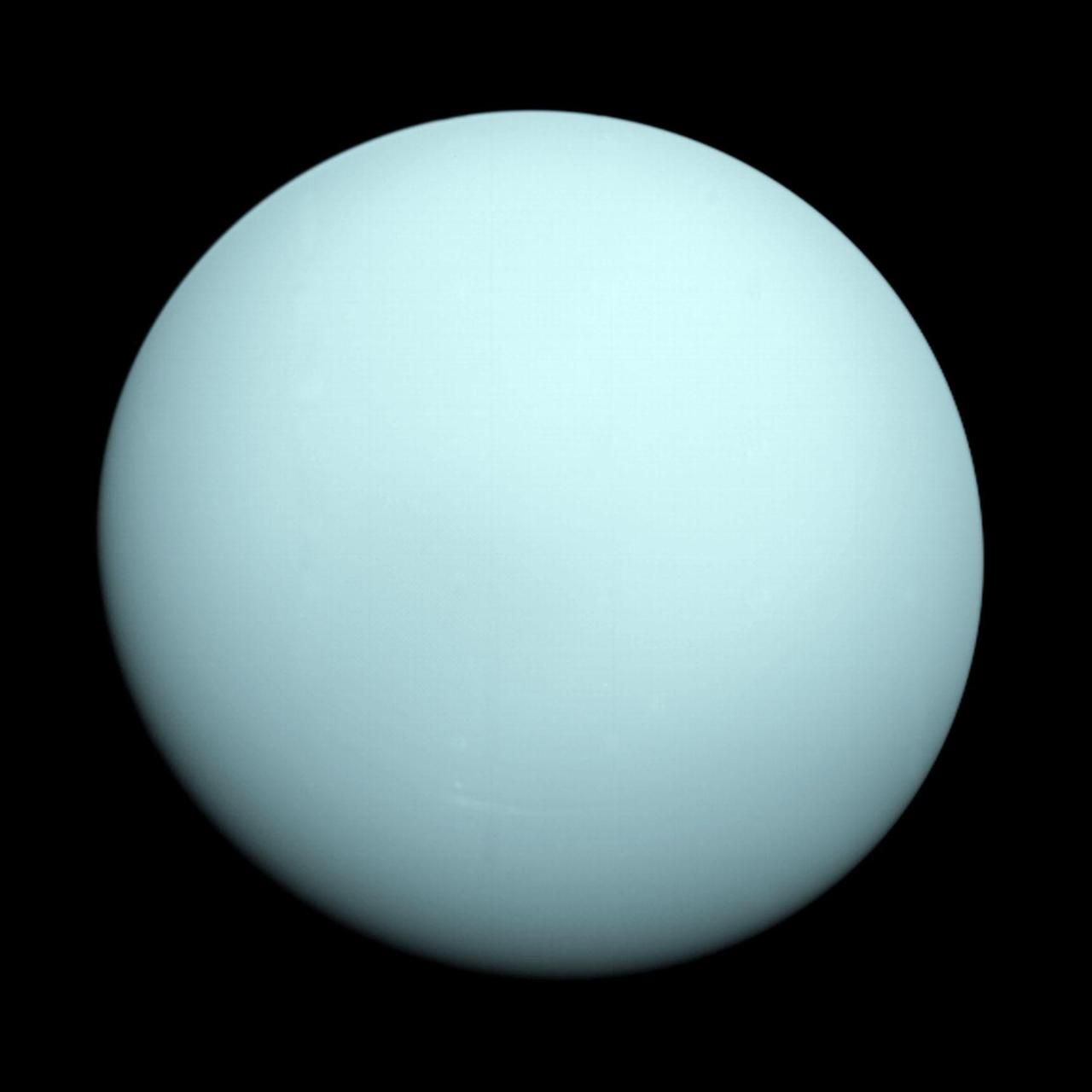
Uranus is a blue-green planet, far away from the Sun. What makes it special: it lies on its side and rolls around the Sun, so to speak. It is icy cold there.
Fact file
- Type
- Planet
- Diameter
- 50,724 km
- Distance from the Sun
- 2,871,000,000 km
- Orbital period
- 83.7 years
- Shape of orbit (eccentricity)
- 0.046 (0 = circle)
- Orbital inclination
- 0.77° to Earth’s orbit
- Axial tilt
- 97.8°
- Temperature
- -197 °C on average
- Mass
- 14.5 Earth masses
- Gravity
- 0.89 times as strong as on Earth
- Escape velocity
- 21.3 km/s
- Length of day
- 17 hours 14 minutes (spinning backwards)
- Number of moons
- 28
Interesting facts about Uranus
- Uranus lies almost completely “on its side” – its rotation axis is tilted by 98°, probably because of a huge collision in its early days.
- That is why its 13 thin, dark rings stand almost upright instead of lying flat like Saturn's.
- Uranus was the first planet to be discovered with a telescope (1781, William Herschel).
- The blue-green colour comes from methane in the atmosphere, which absorbs red light.
Frequently asked questions about Uranus
Why does Uranus lie on its side?
The rotation axis of Uranus is tilted by 98°, so it almost rolls along its orbit. It probably collided with a large body early in the history of the Solar System and was tipped over.
Why is Uranus blue-green?
There is methane in the atmosphere of Uranus. This gas absorbs the red part of sunlight, leaving blue-green.
Who discovered Uranus?
William Herschel discovered Uranus in 1781. Uranus was the first planet to be found with a telescope.
How big is Uranus?
Uranus has a diameter of 50,724 km. That is about 4 times the diameter of Earth.
How far is Uranus from the Sun?
Uranus is on average 2.87 billion km from the Sun. That is 19.19 astronomical units (AU). Sunlight takes about 2.7 hours to cover this distance.
How long is a year on Uranus?
Uranus takes 83.7 Earth years to travel once around the Sun.
How many moons does Uranus have?
Uranus has 28 known moons. The best known include Miranda, Ariel, Umbriel and Titania.
How cold or warm is it on Uranus?
On Uranus the average temperature is −197 °C.
The ring system
Uranus has 13 known rings. They were discovered in 1977, when Uranus passed in front of a star and the star's light briefly flickered several times. The rings are very narrow (mostly under 10 km), extremely dark and made of ice and dark material. Because Uranus is tilted by 98°, the rings stand almost upright – like a target rolling towards the viewer. Neptune has rings too, but they are faint and not tilted as much.
Name and discovery
After Ouranos, the Greek god of the sky – the only planet with a Greek rather than a Roman name.
Discovered on 13 March 1781 by William Herschel with a home-made telescope in Bath, England – the first planet found with a telescope.
Formation
Uranus is one of the “ice giants” – it formed further out from ice, rock and gas and contains less hydrogen/helium than Jupiter and Saturn.
Atmosphere
The atmosphere is made of hydrogen, helium and methane; beneath it there is thought to be a hot ocean of water, ammonia and methane above a rocky core.
Exploration
Uranus has been visited only once so far: by Voyager 2 in 1986, in a flyby. NASA is planning a dedicated orbiter mission for the 2030s.
Compared with Earth
Uranus is 4 times the diameter of Earth and about 14 times as heavy.
Structure: what Uranus looks like inside
- Rocky core: A core of rock and iron, about as heavy as half an Earth to a whole one.
- Ice mantle: Not ice in the everyday sense: a hot, dense fluid of water, ammonia and methane. It may even rain diamonds in there.
- Hydrogen-helium envelope: The outer gas envelope, with a little methane that absorbs red light and gives Uranus its blue-green colour.
Moons of Uranus
Uranus has 28 known moons. These 6 have a fact file of their own:
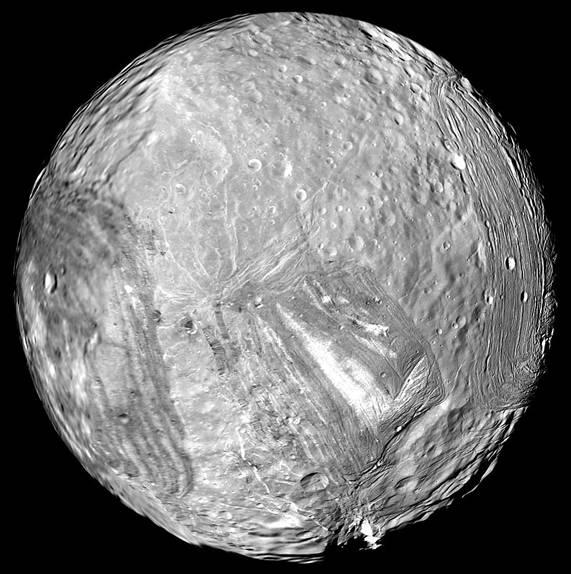 MirandaMiranda has what is probably the highest cliff in the Solar System: Verona Rupes is up to 20 km high.
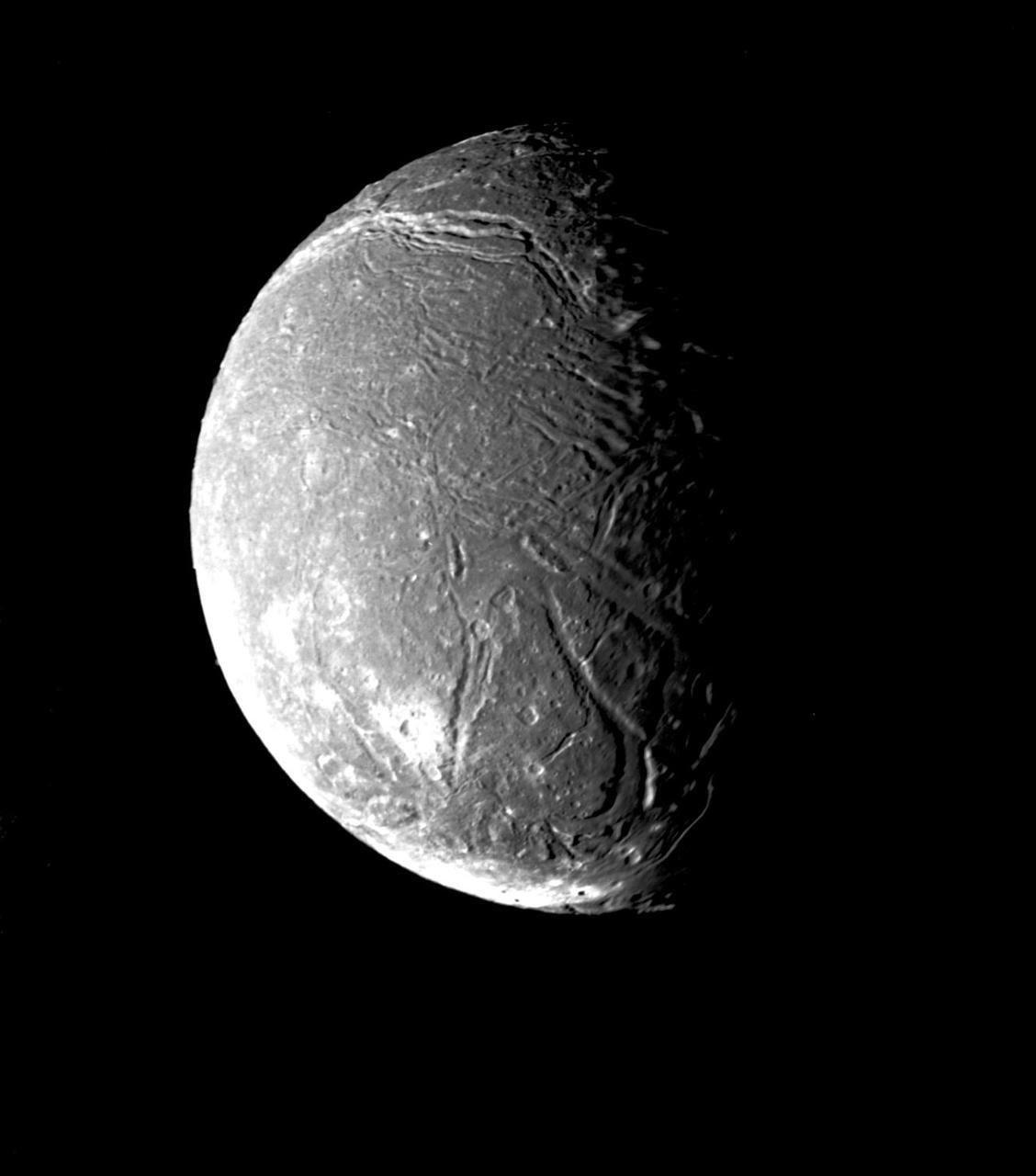 ArielAriel is the brightest moon of Uranus and has the youngest surface – with relatively few craters.
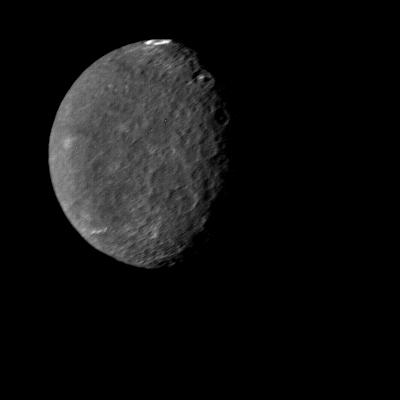 UmbrielUmbriel is the darkest of Uranus's large moons.
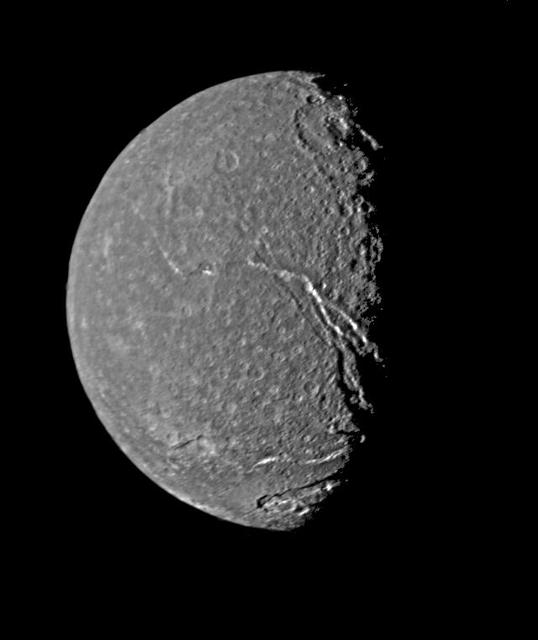 TitaniaTitania is the largest moon of Uranus and the eighth-largest moon in the Solar System.
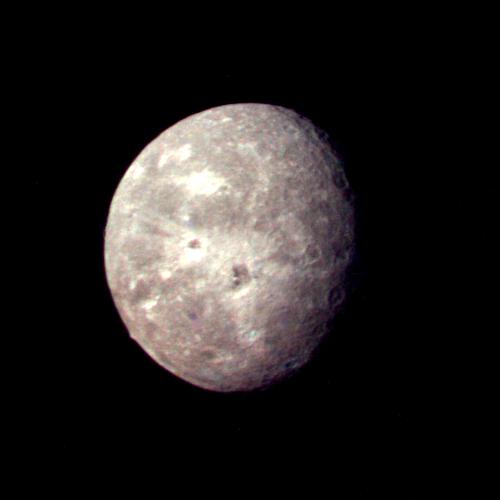 OberonOberon is the outermost of Uranus's large moons.
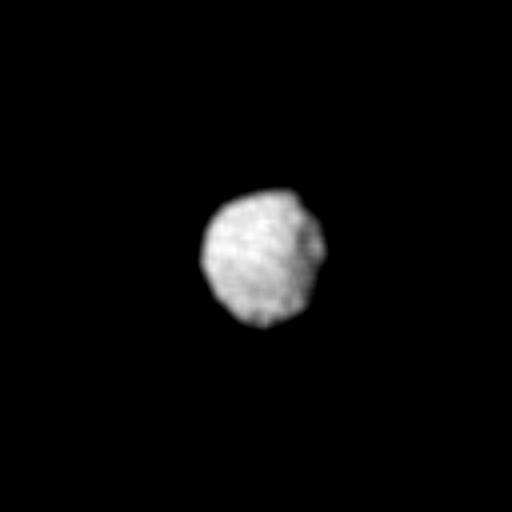 PuckPuck was discovered by Voyager 2 in December 1985 – a few weeks before its flyby of Uranus.
Space probes at Uranus
Test your knowledge of Uranus
Which planet practically “rolls” around the Sun on its side (axial tilt about 98°)?
Uranus. A giant impact early in its history probably tipped Uranus over. That is why its rings stand “upright”.
The full quiz with points and badges is in the 3D model under “Explore”.
Uranus in the tours
This site is free and has no banner ads. Here is how you can support it