Moon of Saturn
Titan
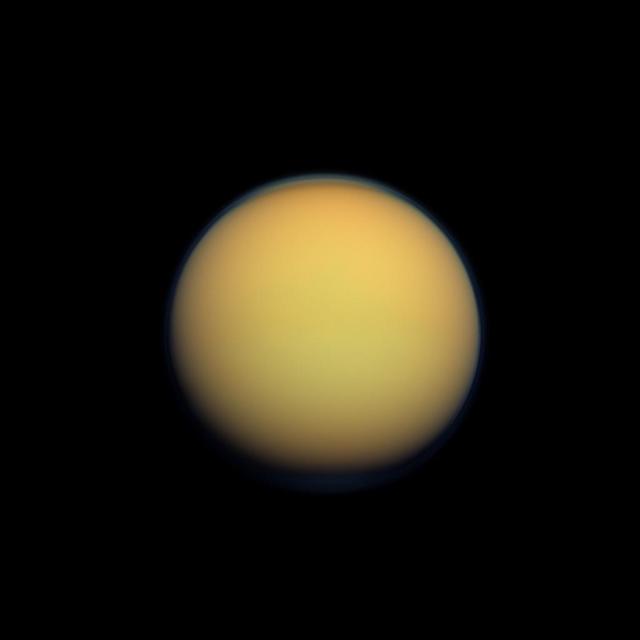
Titan is the biggest moon of Saturn. It has thick, orange air. It rains there – but not water: liquid gas. There are even lakes and rivers of it.
Fact file
- Type
- Moon of Saturn
- Diameter
- 5,150 km
- Distance from Saturn
- 1,221,900 km
- Orbital period
- 16 days
- Temperature
- -179 °C on average
- Mass
- 0.0225 Earth masses
- Gravity
- 0.14 times as strong as on Earth
- Escape velocity
- 2.6 km/s
- Length of day
- 15.9 Earth days (tidally locked)
Titan orbits Saturn.
Interesting facts about Titan
- Titan is the only moon in the Solar System with a dense atmosphere – denser even than Earth's.
- There are lakes and rivers on its surface – but of liquid methane and ethane instead of water.
- Titan is the second-largest moon in the Solar System, after Ganymede.
Frequently asked questions about Titan
What is special about Titan?
Titan is the only moon with a dense atmosphere – it is even denser than Earth's. There are lakes and rivers on its surface, though they are made of liquid methane and ethane instead of water.
Has a probe ever landed on Titan?
Yes. The European probe Huygens landed on Titan on 14 January 2005. It had travelled to Saturn with the Cassini spacecraft.
How big is Titan?
Titan has a diameter of 5,150 km. That is about 148% of the diameter of our Moon.
How far is Titan from Saturn?
Titan orbits Saturn at an average distance of 1.2 million km.
How long does Titan take to orbit Saturn?
Titan orbits Saturn once every 16 days.
How cold or warm is it on Titan?
On Titan the average temperature is −179 °C.
Name and discovery
After the Titans, the mighty race of gods in Greek myth.
Discovered on 25 March 1655 by Christiaan Huygens – the first known moon of Saturn.
Formation
Titan formed from the disc around the young Saturn and, thanks to its size, was able to hold on to a dense atmosphere.
Atmosphere
The atmosphere is 95% nitrogen (similar to Earth's) and contains methane clouds that drive a methane cycle of its own.
Exploration
The Huygens lander (part of Cassini-Huygens) touched down successfully on Titan in 2005. NASA's Dragonfly mission (launch planned for 2028) is to send a flying robot there.
Compared with Earth
Titan is the only moon with a “weather” system similar to Earth's – only with methane instead of water.
Structure: what Titan looks like inside
- Rocky core: Water-bearing silicate rock.
- High-pressure ice: Dense ice under high pressure.
- Ocean: An underground ocean of salty water and ammonia.
- Ice crust: Ice as hard as rock, with lakes of liquid methane on top.
- Atmosphere: Denser than Earth's atmosphere (1.5 times the pressure), mostly nitrogen, with an orange haze of organic compounds.
The surface: 13 places on Titan
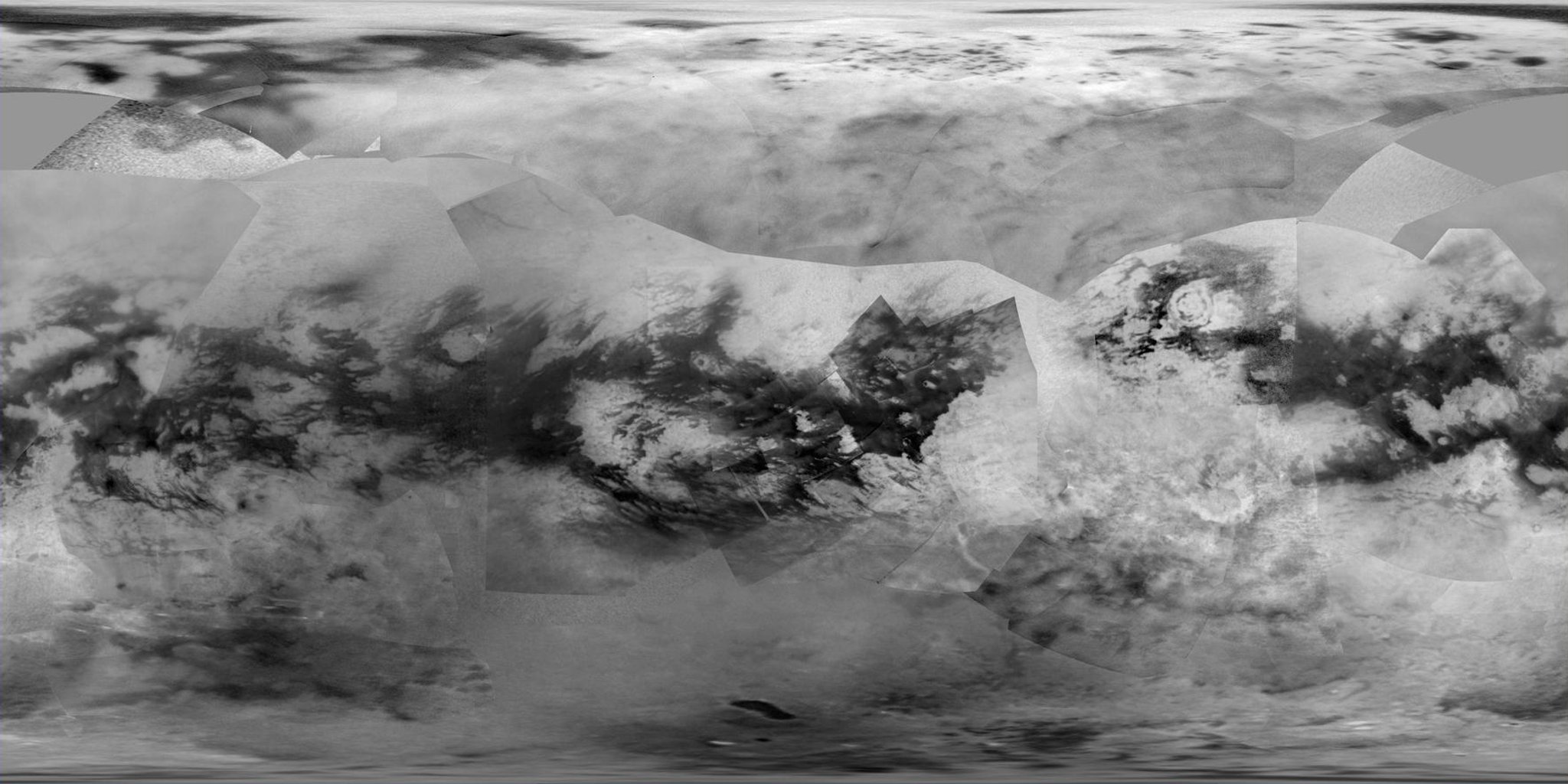
In visible light Titan is shrouded in orange haze – this map was made in the infrared. Dark = dunes and lakes, bright = highlands.
Seas and plains
- Kraken Mare
- The largest sea on Titan – bigger than the Caspian Sea. It is made of liquid methane and ethane at -180 °C.
- Ligeia Mare
- The second-largest sea, more than 160 m deep in places. Cassini observed mysterious “magic islands” here that appeared and disappeared.
- Punga Mare
- The third large sea, very close to the north pole.
- Ontario Lacus
- The largest lake in the southern hemisphere – about the size of Lake Ontario in North America.
Regions
- Xanadu
- A bright “continent” the size of Australia – a rugged, ancient highland region.
- Shangri-La
- A dark sea of dunes at the equator. The dunes are made not of sand but of grains of organic material.
- Belet
- Another vast dune field; individual dunes are more than 100 m high and hundreds of kilometres long.
- Adiri
- A bright region; the Huygens probe landed at its edge.
Craters
- Menrva
- The largest crater on Titan (425 km) – recognisable on the map as a ring structure.
- Selk
- A crater (around 90 km), the target of NASA's Dragonfly mission: a drone helicopter is due to fly there from the 2030s and search for the building blocks of life.
- Sinlap
- A well-preserved crater (80 km) with bright ejecta.
Mountains and volcanoes
- Sotra Patera
- A depression 1.7 km deep next to mountains – a candidate for an ice volcano.
Landing sites
- Huygens – landing site
- On 14 January 2005 the European probe Huygens landed here and photographed rounded pebbles of ice – as in a dried-up riverbed.
In the 3D model you can click on these places on the map.
Other moons of Saturn
Test your knowledge of Titan
Which moon of Saturn has a dense atmosphere and lakes of methane?
Titan. Titan is the only moon with a dense atmosphere. The European probe Huygens landed there in 2005.
Which European probe landed on Saturn's moon Titan in 2005?
Huygens. To this day, Huygens is the most distant landing from Earth ever made.
The full quiz with points and badges is in the 3D model under “Explore”.
Titan in the tours
This site is free and has no banner ads. Here is how you can support it