Moon of Saturn
Enceladus
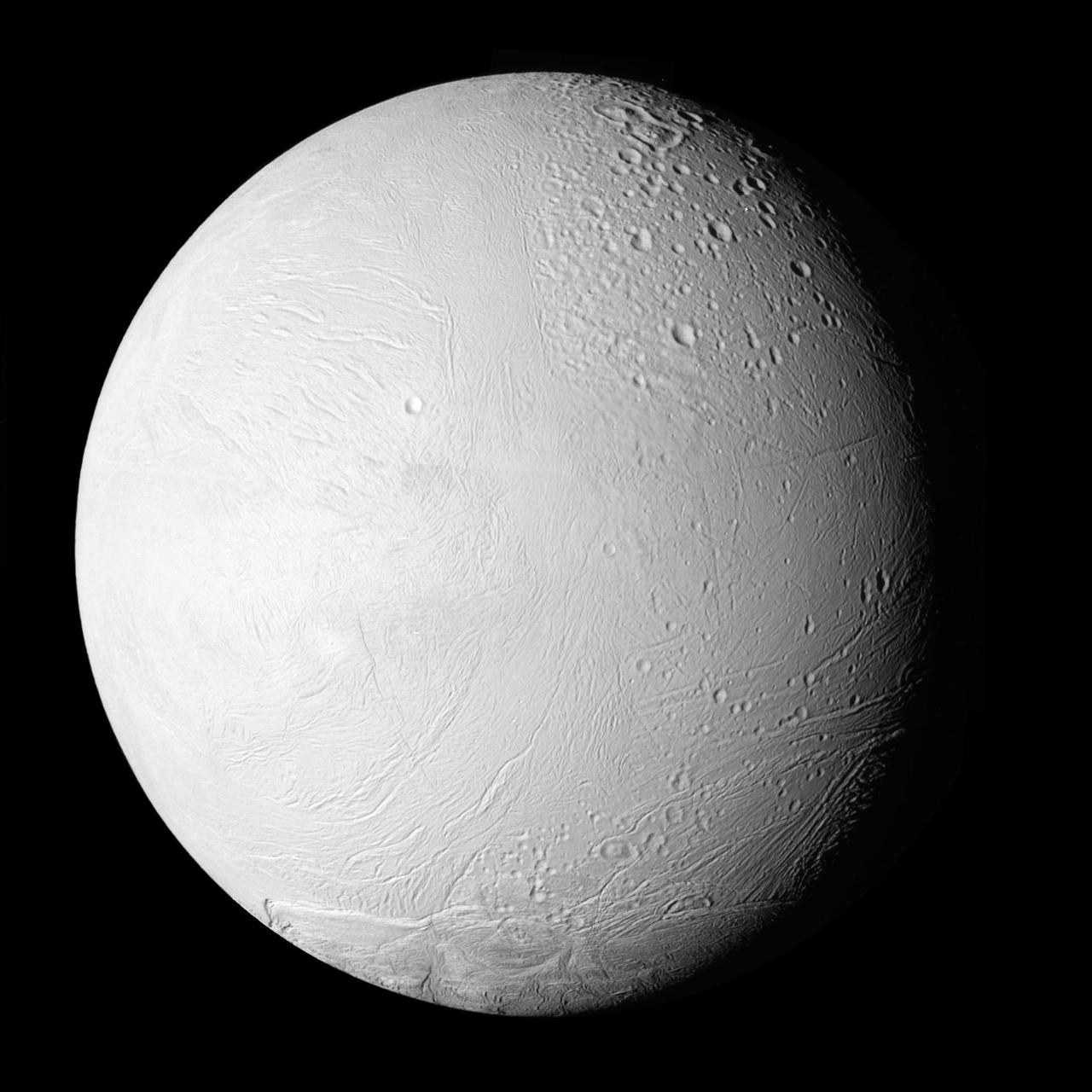
Enceladus is a small, snow-white moon of Saturn. Huge fountains of water spray out of cracks in the ice into space – like geysers.
Fact file
- Type
- Moon of Saturn
- Diameter
- 504 km
- Distance from Saturn
- 238,400 km
- Orbital period
- 1.4 days
- Temperature
- -198 °C on average
- Mass
- 0.000018 Earth masses
- Gravity
- 0.011 times as strong as on Earth
- Escape velocity
- 0.24 km/s
- Length of day
- 1.4 Earth days (tidally locked)
Enceladus orbits Saturn.
Interesting facts about Enceladus
- Enceladus shoots huge fountains of water vapour and ice into space from cracks at its south pole.
- These fountains feed Saturn's outer E ring with ice particles.
- A global ocean of liquid water is hidden beneath the icy crust.
Frequently asked questions about Enceladus
What are the fountains of Enceladus?
Water vapour and ice particles shoot out into space from cracks at the south pole of Enceladus. They come from an ocean beneath the icy crust and feed Saturn's outer E ring. They were discovered by the Cassini spacecraft.
How big is Enceladus?
Enceladus has a diameter of 504 km. That is about 15% of the diameter of our Moon.
How far is Enceladus from Saturn?
Enceladus orbits Saturn at an average distance of 238,400 km.
How long does Enceladus take to orbit Saturn?
Enceladus orbits Saturn once every 32.9 hours.
How cold or warm is it on Enceladus?
On Enceladus the average temperature is −198 °C.
Name and discovery
After Enceladus, a giant of Greek myth said to lie buried beneath Mount Etna.
Discovered on 28 August 1789 by William Herschel.
Formation
Enceladus formed from Saturn's disc; Saturn's tidal forces heat its interior and keep the ocean liquid.
Atmosphere
No permanent atmosphere, but a local cloud of water vapour at the south pole, fed by the geysers.
Exploration
The Cassini probe flew through the fountains several times and found organic molecules in them – a sign that it might be habitable.
Compared with Earth
At only 504 km across, Enceladus is tiny, yet it is considered one of the most promising places for extraterrestrial life.
Structure: what Enceladus looks like inside
- Rocky core: A porous rocky core through which water circulates and warms up – as in a sponge.
- Ocean: A global ocean, 26-31 km deep, with salt, silica and organic molecules.
- Ice crust: Around 20 km thick on average, only a few km at the south pole – where the jets shoot out into space through the “tiger stripes”.
Other moons of Saturn
Test your knowledge of Enceladus
Which small moon of Saturn shoots fountains of water into space?
Enceladus. The fountains at the south pole come from an ocean beneath the ice and feed Saturn's E ring.
The full quiz with points and badges is in the 3D model under “Explore”.
Enceladus in the tours
This site is free and has no banner ads. Here is how you can support it