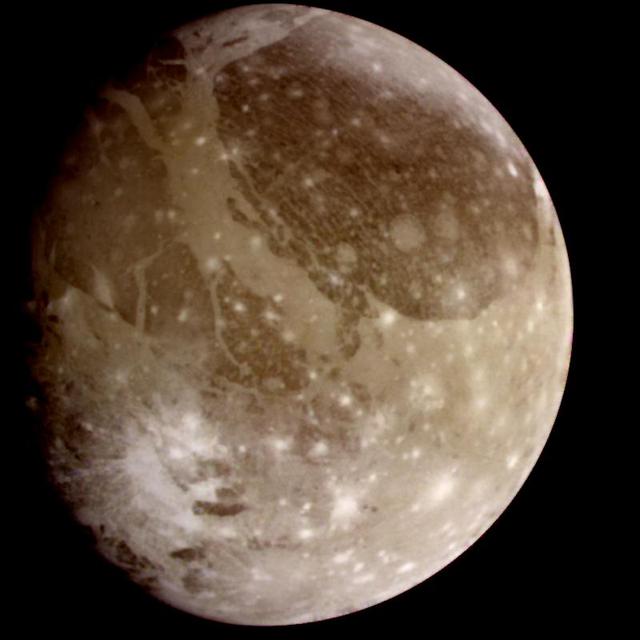
Moon of Jupiter
Ganymede
Ganymede is the biggest moon in the whole Solar System – it is even bigger than the planet Mercury. It orbits Jupiter.
Fact file
- Type
- Moon of Jupiter
- Diameter
- 5,268 km
- Distance from Jupiter
- 1,070,400 km
- Orbital period
- 7.2 days
- Temperature
- -160 °C on average
- Mass
- 0.025 Earth masses
- Gravity
- 0.15 times as strong as on Earth
- Escape velocity
- 2.7 km/s
- Length of day
- 7.2 Earth days (tidally locked)
Ganymede orbits Jupiter.
Interesting facts about Ganymede
- Ganymede is the largest moon in the Solar System – bigger than the planet Mercury.
- It is the only moon with an active magnetic field of its own.
- A salty ocean is thought to lie beneath Ganymede's surface too.
Frequently asked questions about Ganymede
Is Ganymede bigger than Mercury?
Yes. Ganymede has a diameter of 5,268 km, Mercury only 4,879 km. That makes Ganymede the largest moon in the Solar System. But because it contains a lot of ice, it is lighter than Mercury.
How big is Ganymede?
Ganymede has a diameter of 5,268 km. That is about 1.5 times the diameter of our Moon.
How far is Ganymede from Jupiter?
Ganymede orbits Jupiter at an average distance of 1.1 million km.
How long does Ganymede take to orbit Jupiter?
Ganymede orbits Jupiter once every 7.2 days.
How cold or warm is it on Ganymede?
On Ganymede the average temperature is −160 °C.
Name and discovery
After Ganymede, cupbearer to the gods on Mount Olympus.
Discovered in January 1610 by Galileo Galilei.
Formation
Ganymede formed from the circumjovian disc and is strongly differentiated: a rocky core, an ice mantle and an ice crust.
Atmosphere
An extremely thin oxygen exosphere has been detected, but no real atmosphere.
Exploration
ESA's JUICE mission (launched 2023) is due to go into orbit around Ganymede in the 2030s, as the first orbiter of a moon other than Earth's.
Compared with Earth
Ganymede is bigger than the planet Mercury, but less massive because of its lower density.
Structure: what Ganymede looks like inside
- Iron core: Partly liquid – Ganymede is the only moon with a magnetic field of its own.
- Rocky mantle: Silicate rock.
- High-pressure ice: Ice that the enormous pressure has forced into a different, denser crystal form.
- Ocean: A salty ocean between layers of ice – with more water than all of Earth's oceans. Like a sandwich of ice and water.
- Ice crust: An ice crust around 150 km thick, with dark old regions and bright grooved ones.
The surface: 7 places on Ganymede
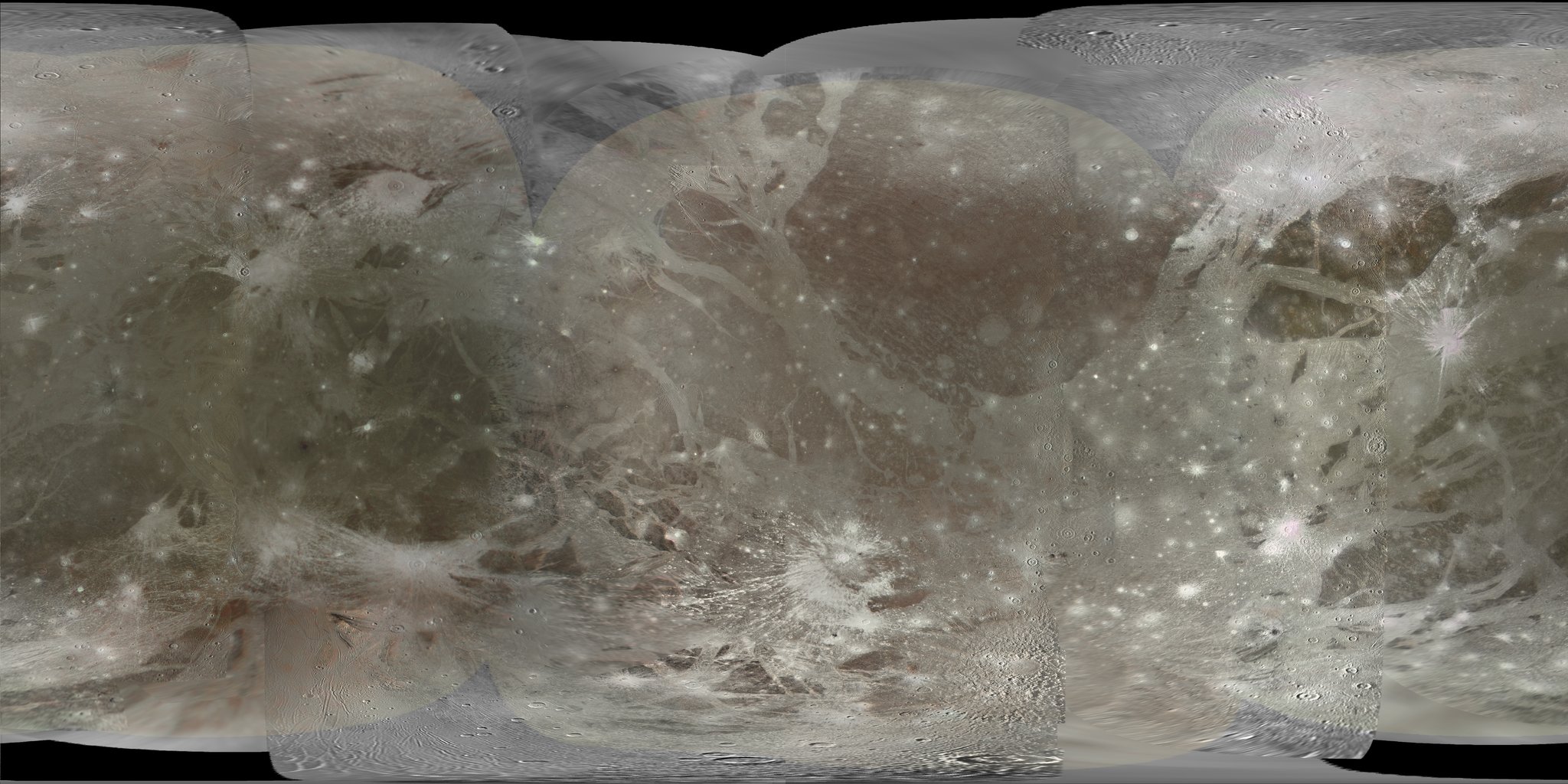
Dark regions are ancient and full of craters; the bright, grooved bands are younger.
Regions
- Galileo Regio
- The largest dark region (around 3,200 km) – one of the oldest surfaces in the Solar System, around 4 billion years old.
- Marius Regio
- Another old, dark region, criss-crossed by bright grooves.
- Uruk Sulcus
- Bright, grooved terrain: here the ice crust was pulled apart and shaped into long grooves.
Craters
- Tros
- A bright ray crater (94 km) – the fresh rays of ice stand out clearly on the map.
- Osiris
- A young crater with long, bright rays.
- Gilgamesh
- The largest impact basin on Ganymede, around 590 km across.
- Enki Catena
- A chain of 13 craters – formed when a comet torn apart by Jupiter struck like a string of pearls (much like Shoemaker-Levy 9).
In the 3D model you can click on these places on the map.
Other moons of Jupiter
Test your knowledge of Ganymede
Which is the largest moon in the Solar System?
Ganymede. Ganymede is bigger than the planet Mercury and the only moon with its own magnetic field.
How many “Galilean moons” does Jupiter have?
4. Io, Europa, Ganymede and Callisto – discovered in 1610 by Galileo Galilei with one of the first telescopes.
Which of these moons is bigger than the planet Mercury?
Ganymede. Ganymede (5,268 km) and Titan too (5,150 km) are bigger than Mercury (4,879 km) – but much lighter.
The full quiz with points and badges is in the 3D model under “Explore”.
Ganymede in the tours
This site is free and has no banner ads. Here is how you can support it