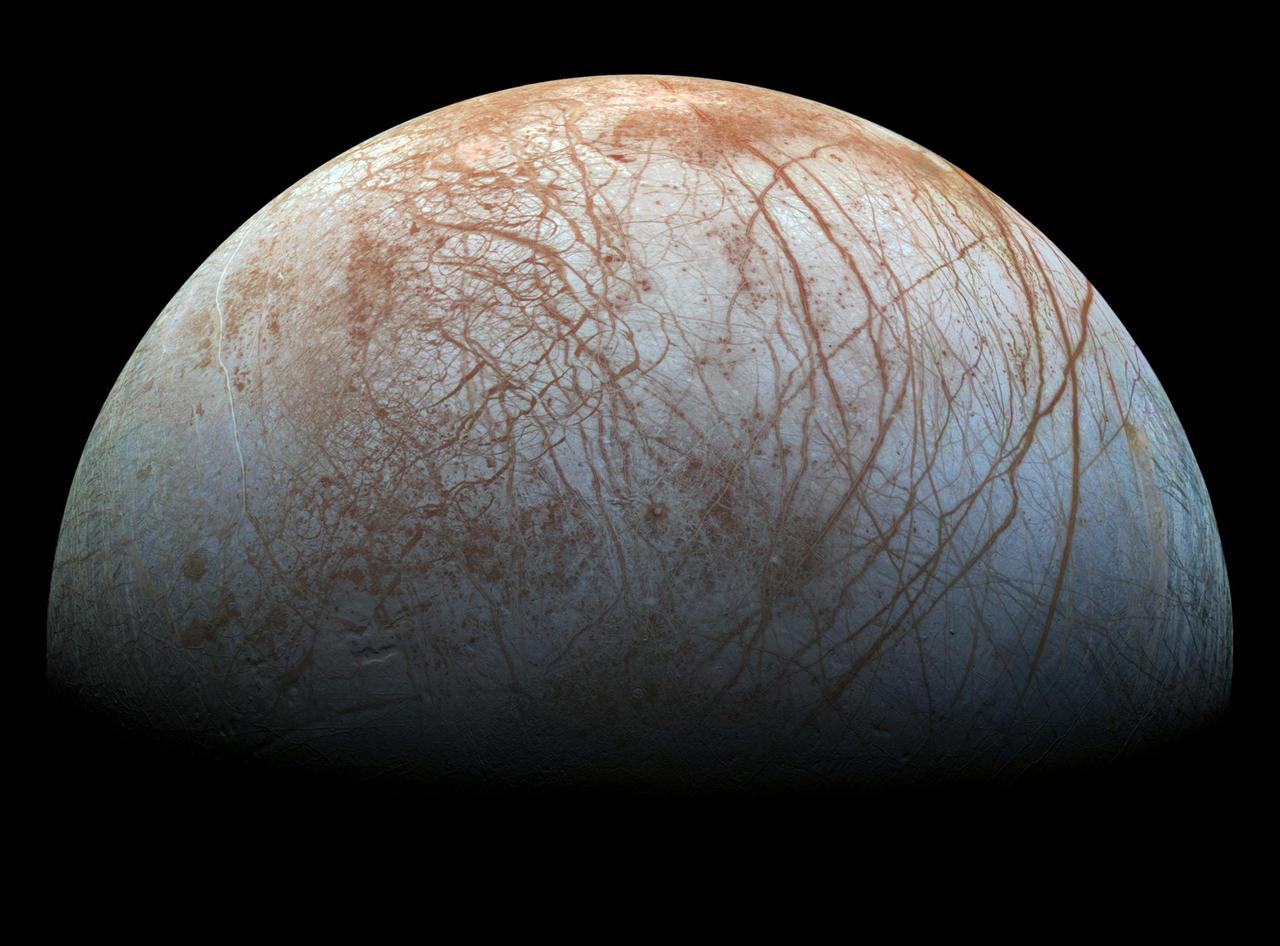
Moon of Jupiter
Europa
Europa is a moon of Jupiter with a thick layer of ice. Underneath it hides a huge sea of water. Perhaps there are even tiny living things there!
Fact file
- Type
- Moon of Jupiter
- Diameter
- 3,122 km
- Distance from Jupiter
- 671,100 km
- Orbital period
- 3.6 days
- Temperature
- -160 °C on average
- Mass
- 0.008 Earth masses
- Gravity
- 0.13 times as strong as on Earth
- Escape velocity
- 2 km/s
- Length of day
- 3.6 Earth days (tidally locked)
Europa orbits Jupiter.
Interesting facts about Europa
- Beneath Europa's icy crust there is thought to be a global ocean of liquid water – with more water than all of Earth's oceans put together.
- The surface is criss-crossed by a network of reddish cracks.
- Europa is considered one of the most promising candidates for extraterrestrial life in the Solar System.
Frequently asked questions about Europa
Is there life on Europa?
Nobody knows. Beneath Europa's icy crust there is probably an ocean of liquid water, holding more water than all of Earth's seas. That is why Europa is seen as one of the most promising places to search for life. The Europa Clipper and JUICE probes are on their way to study the moon more closely.
How big is Europa?
Europa has a diameter of 3,122 km. That is about 90% of the diameter of our Moon.
How far is Europa from Jupiter?
Europa orbits Jupiter at an average distance of 671,100 km.
How long does Europa take to orbit Jupiter?
Europa orbits Jupiter once every 3.6 days.
How cold or warm is it on Europa?
On Europa the average temperature is −160 °C.
Name and discovery
After the Phoenician princess Europa – the continent of Europe is named after her too.
Discovered in January 1610 by Galileo Galilei.
Formation
Europa formed from the disc of gas and dust around the young Jupiter, like the other Galilean moons.
Atmosphere
Only an extremely thin oxygen exosphere, created by radiation knocking water molecules out of the ice.
Exploration
NASA's Europa Clipper mission (launched 2024) is to study the ocean beneath the ice more closely.
Compared with Earth
Europa is slightly smaller than our Moon, but could hold more liquid water beneath its icy crust than the whole of Earth.
Structure: what Europa looks like inside
- Iron core: A core of iron and iron sulphide.
- Rocky mantle: Silicate rock. On the sea floor above it there could be hot springs – like those in Earth's deep sea, where life exists.
- Saltwater ocean: A global ocean, around 60-150 km deep – it probably holds twice as much water as all of Earth's oceans. One of the most promising places to look for extraterrestrial life.
- Ice crust: A shell of water ice, probably 15-25 km thick, with cracks and bands.
The ocean and ice crust are drawn a little thicker so that you can see them.
The surface: 8 places on Europa
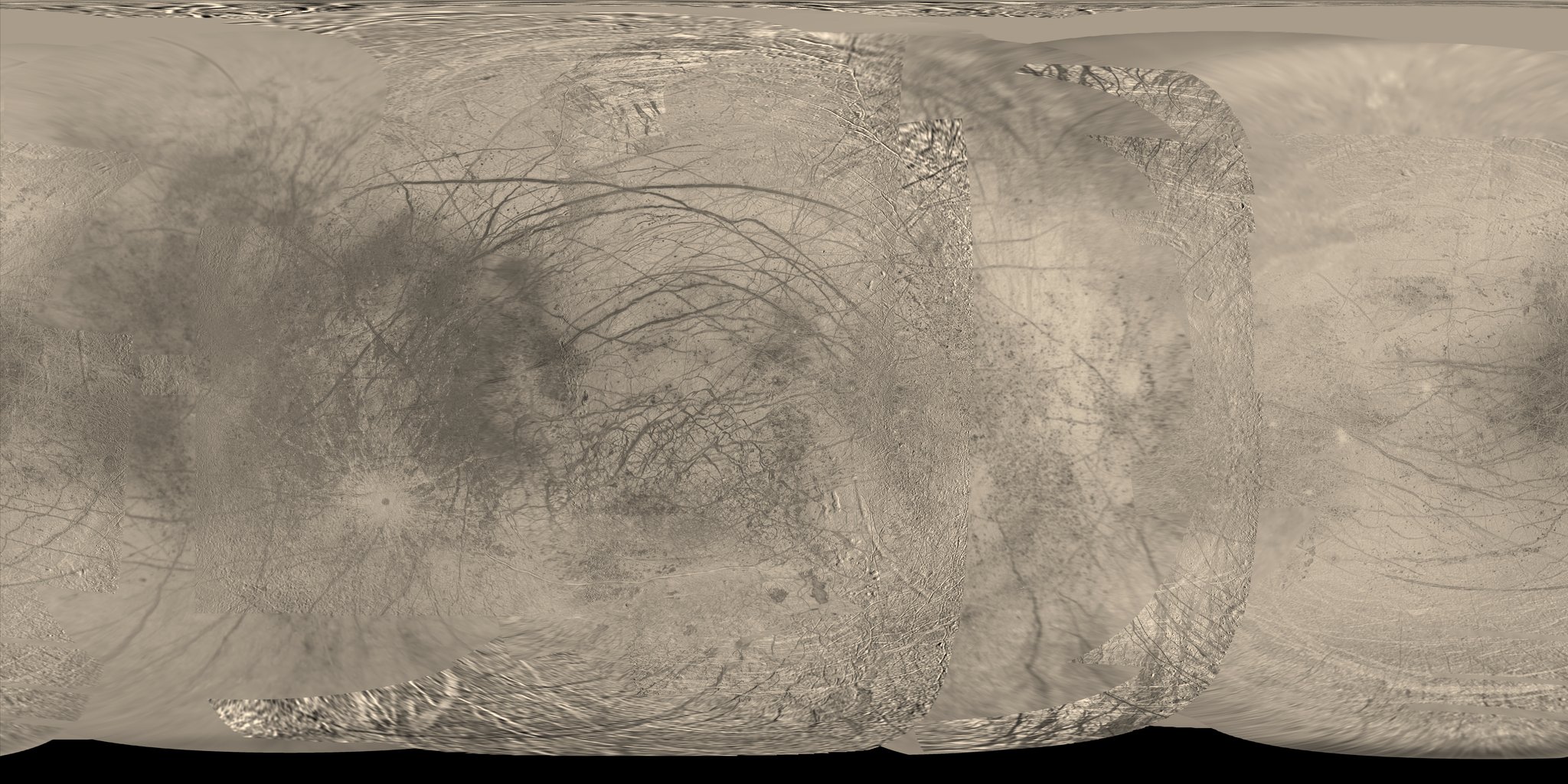
Beneath the shell of ice there is probably a global ocean. The dark lines are cracks and bands in the ice.
Craters
- Pwyll
- One of the youngest large craters (26 km). Its bright rays of fresh ice reach more than 1,000 km – Europa has hardly any craters, because its surface is constantly being renewed.
- Tyre
- A ring basin (around 40 km) with concentric rings – like a bullseye. The impact probably punched through almost the whole ice crust.
- Callanish
- Another ring basin, similar to Tyre.
- Cilix
- A small crater that serves as the reference point for Europa's longitudes (by definition it lies at 182° west).
Regions
- Conamara Chaos
- A region of broken, shifted ice rafts – like pack ice on a frozen sea. A sign that water or soft ice once welled up here.
- Thera Macula
- A dark region of chaos terrain. Researchers suspect a lake of liquid water beneath it, enclosed in the ice.
- Thrace Macula
- A dark, reddish region next to Thera Macula – probably salty material that has risen from the depths.
- Agenor Linea
- A strikingly bright, long band in the ice – along bands like this the crust has pulled apart.
In the 3D model you can click on these places on the map.
Other moons of Jupiter
Test your knowledge of Europa
Beneath which icy shell is a global ocean of liquid water thought to lie – on a moon of Jupiter?
Europa. Europa probably has twice as much water as all of Earth's oceans combined – a hot candidate for life.
The full quiz with points and badges is in the 3D model under “Explore”.
Europa in the tours
Books on this topic
Advertisement As an Amazon Associate I earn from qualifying purchases. All books
This site is free and has no banner ads. Here is how you can support it