Home › Universe › Large Magellanic Cloud
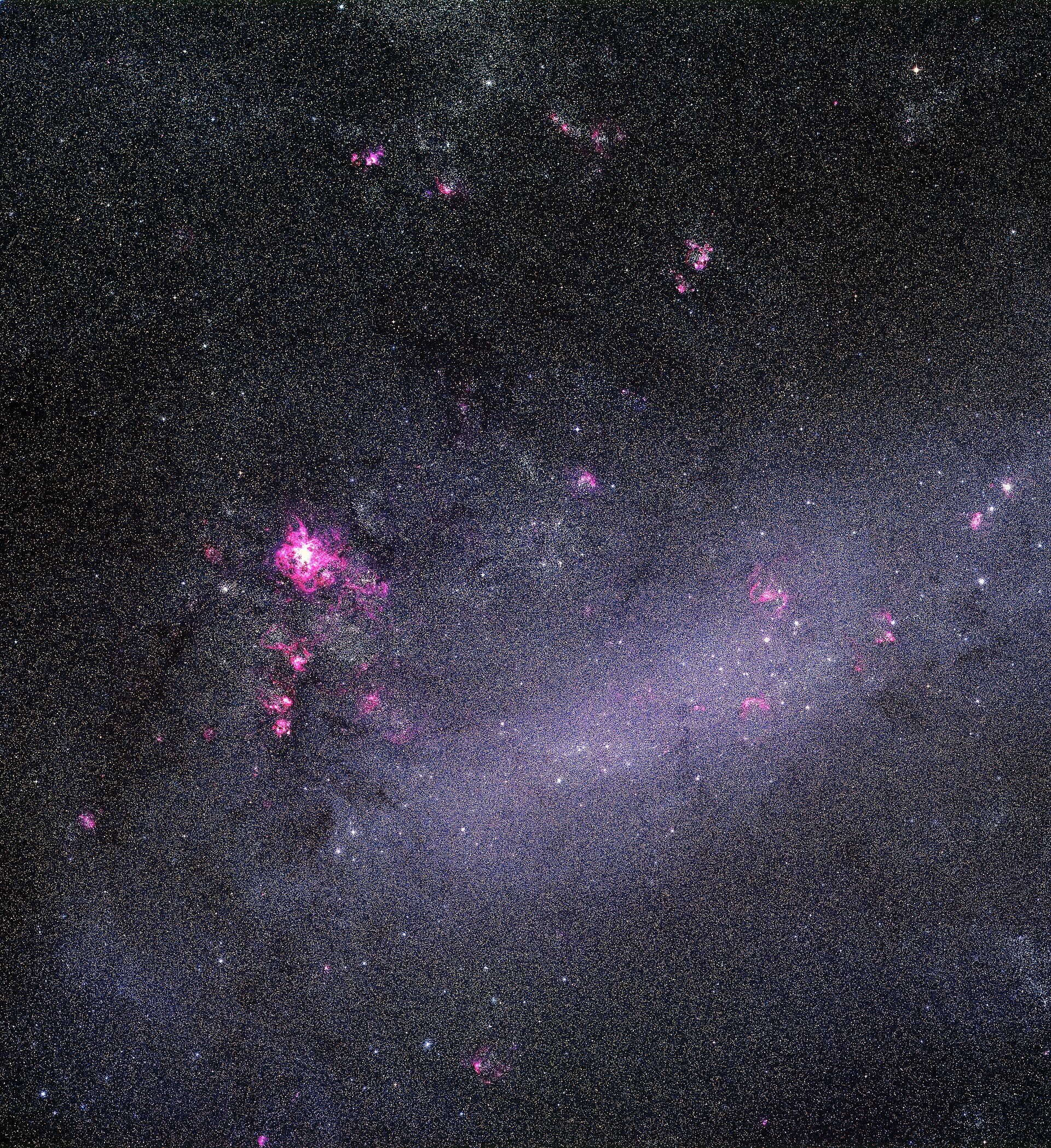

Dwarf galaxy – companion of the Milky Way
Large Magellanic Cloud
In 1987 a star exploded here: Supernova 1987A, the nearest stellar explosion observed since 1604 – visible to the naked eye.
Key figures
- Distance
- 160,000 light-years
- Diameter
- about 14,000 light-years
- Stars
- about 30 billion
- In the sky
- visible only from the southern hemisphere
Interesting facts
- The Tarantula Nebula in the Large Magellanic Cloud is the largest star-forming region in the whole Local Group.
Name
Named after the seafarer Ferdinand Magellan, whose crew described the clouds during the first voyage around the world in 1519. The people of the southern hemisphere had of course known them for far longer.
Where is it?
Large Magellanic Cloud belongs to the “The Local Group” level of the Cosmic Zoom (field of view about 10 million light-years). The Milky Way is not alone: together with the Andromeda Galaxy, the Triangulum Galaxy and around 80 small dwarf galaxies it forms the Local Group.
This site is free and has no banner ads. Here is how you can support it