Home › Solar System › Asteroid Belt
Belt
Asteroid Belt
Between Mars and Jupiter, millions of chunks of rock fly around the Sun: the Asteroid Belt. They were left over when the planets formed. Even so, there is a great deal of empty space there.
Fact file
- Type
- Belt
- Distance from the Sun
- 400,000,000 km
- Orbital period
- 4.6 years
- Temperature
- -108 °C on average (from -145 to -70 °C)
Interesting facts about the Asteroid Belt
- The Asteroid Belt lies between Mars and Jupiter (2.2 to 3.2 AU) and contains more than a million asteroids larger than 1 km.
- Despite all those lumps of rock it is almost empty: together they weigh only about 4% of the Moon's mass, and two asteroids are on average more than a million kilometres apart – space probes fly through safely.
- It is not a destroyed planet, but material that could never clump together into a planet because of Jupiter's gravity.
Formation
When the Solar System was forming, Jupiter's strong gravity disturbed the material between Mars and Jupiter: the lumps collided too fast and shattered instead of merging. What remained was a belt of primordial material.
Composition
The individual bodies have no atmosphere to speak of.
Exploration
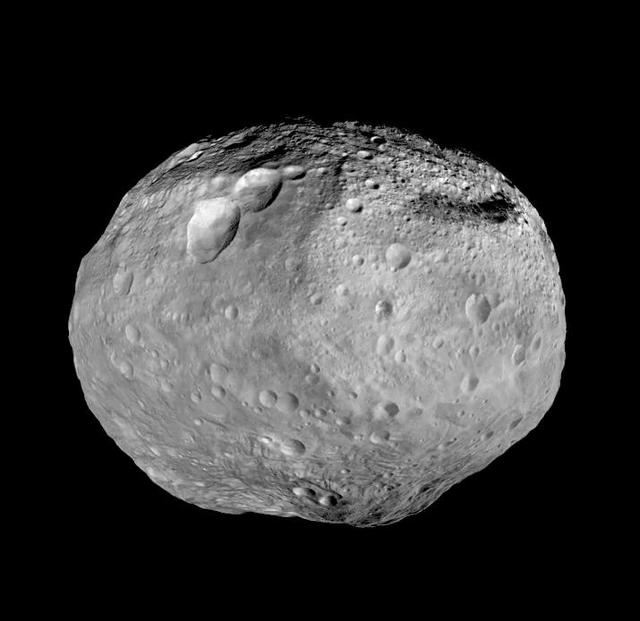
Dawn studied the asteroid Vesta in 2011-2012 and Ceres in 2015-2018. Lucy (since 2021) and Psyche (launched 2023, arrival 2029) are exploring further asteroids; NEAR visited the near-Earth asteroid Eros back in 2000/01.
In comparison
The whole belt contains less mass than our Moon, spread over a space larger than Earth's orbit.
Test your knowledge of the Asteroid Belt
Where is the Asteroid Belt?
Between Mars and Jupiter. Jupiter's gravity prevented a planet from forming there.
The full quiz with points and badges is in the 3D model under “Explore”.
The Asteroid Belt in the tours
This site is free and has no banner ads. Here is how you can support it