Home › Dwarf planets › Pluto
Dwarf planet
Pluto
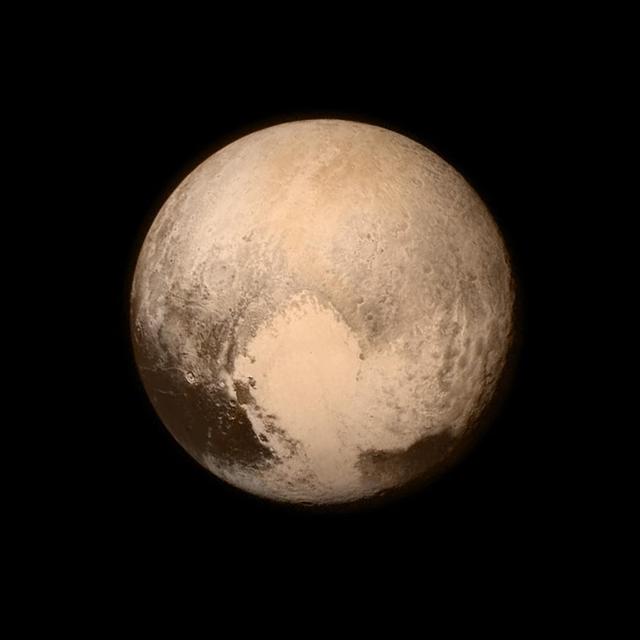
Pluto is a dwarf planet, very far out. It used to count as a planet, but not any more, because it is so small. It has a big bright patch shaped like a heart.
Fact file
- Type
- Dwarf planet
- Diameter
- 2,377 km
- Distance from the Sun
- 5,906,400,000 km
- Orbital period
- 247.9 years
- Temperature
- -229 °C on average (from -240 to -218 °C)
- Mass
- 0.0022 Earth masses
- Gravity
- 0.06 times as strong as on Earth
- Escape velocity
- 1.2 km/s
- Length of day
- 6.4 Earth days (spinning backwards)
- Number of moons
- 5
Interesting facts about Pluto
- Pluto was discovered by Clyde Tombaugh in 1930 and was considered the ninth planet for 76 years – in 2006 the International Astronomical Union reclassified it as a dwarf planet.
- The large heart-shaped region (Tombaugh Regio) is made of nitrogen, methane and carbon monoxide ice; its western half, Sputnik Planitia, is a vast glacier basin.
- Pluto and its largest moon Charon orbit a common centre of mass that lies outside Pluto – almost a double system.
Frequently asked questions about Pluto
Why is Pluto no longer a planet?
Since 2006 the rule has been that a planet must have cleared its orbit of other bodies. Pluto shares its neighbourhood with many icy bodies of the Kuiper Belt. That is why the International Astronomical Union reclassified it as a dwarf planet. Before that it had counted as the ninth planet for 76 years.
What is the heart on Pluto?
The bright, heart-shaped region is called Tombaugh Regio. It is made of nitrogen, methane and carbon monoxide ice. Its western half, Sputnik Planitia, is a vast glacier basin.
Which spacecraft has visited Pluto?
Only one so far: New Horizons flew past Pluto on 14 July 2015 and took the first close-up pictures.
How big is Pluto?
Pluto has a diameter of 2,377 km. That is about 19% of the diameter of Earth.
How far is Pluto from the Sun?
Pluto is on average 5.91 billion km from the Sun. That is 39.48 astronomical units (AU). Sunlight takes about 5.5 hours to cover this distance.
How long is a year on Pluto?
Pluto takes 247.9 Earth years to travel once around the Sun.
How cold or warm is it on Pluto?
On Pluto the average temperature is −229 °C. The temperature ranges from −240 to −218 °C.
Name and discovery
After the Roman god of the underworld. Suggested by Venetia Burney, an eleven-year-old girl from Oxford.
Discovered on 18 February 1930 on photographic plates by 24-year-old Clyde Tombaugh at Lowell Observatory (Arizona).
Formation
Pluto formed about 4.5 billion years ago in the Kuiper Belt, the ring of icy bodies beyond Neptune. Its orbit is strongly elliptical and tilted by 17° to the orbits of the planets; at times it is closer to the Sun than Neptune (most recently 1979-1999).
Atmosphere
Pluto has a very thin atmosphere of nitrogen, methane and carbon monoxide, which expands as it approaches the Sun (ice turns to gas) and freezes out in winter. New Horizons discovered several blue haze layers reaching up to about 200 km.
Exploration
On 14 July 2015, after a 9.5-year journey, NASA's New Horizons probe flew past Pluto at a distance of only about 12,500 km and returned the first close-up images: glaciers, plains of nitrogen ice and mountains of water ice up to 3.5 km high.
Compared with Earth
At 2,377 km across, Pluto is smaller than our Moon (3,474 km) and has only about 0.2% of Earth's mass.
Structure: what Pluto looks like inside
- Rocky core: Around 70% of the radius – Pluto is about two-thirds rock.
- Possible ocean: Beneath the ice, researchers suspect an ocean of water and ammonia – Sputnik Planitia probably lies right above a thin spot.
- Ice mantle: Water ice, covered at the surface by nitrogen, methane and carbon monoxide ice.
- Atmosphere: A wafer-thin nitrogen atmosphere with blue layers of haze.
The surface: 7 places on Pluto
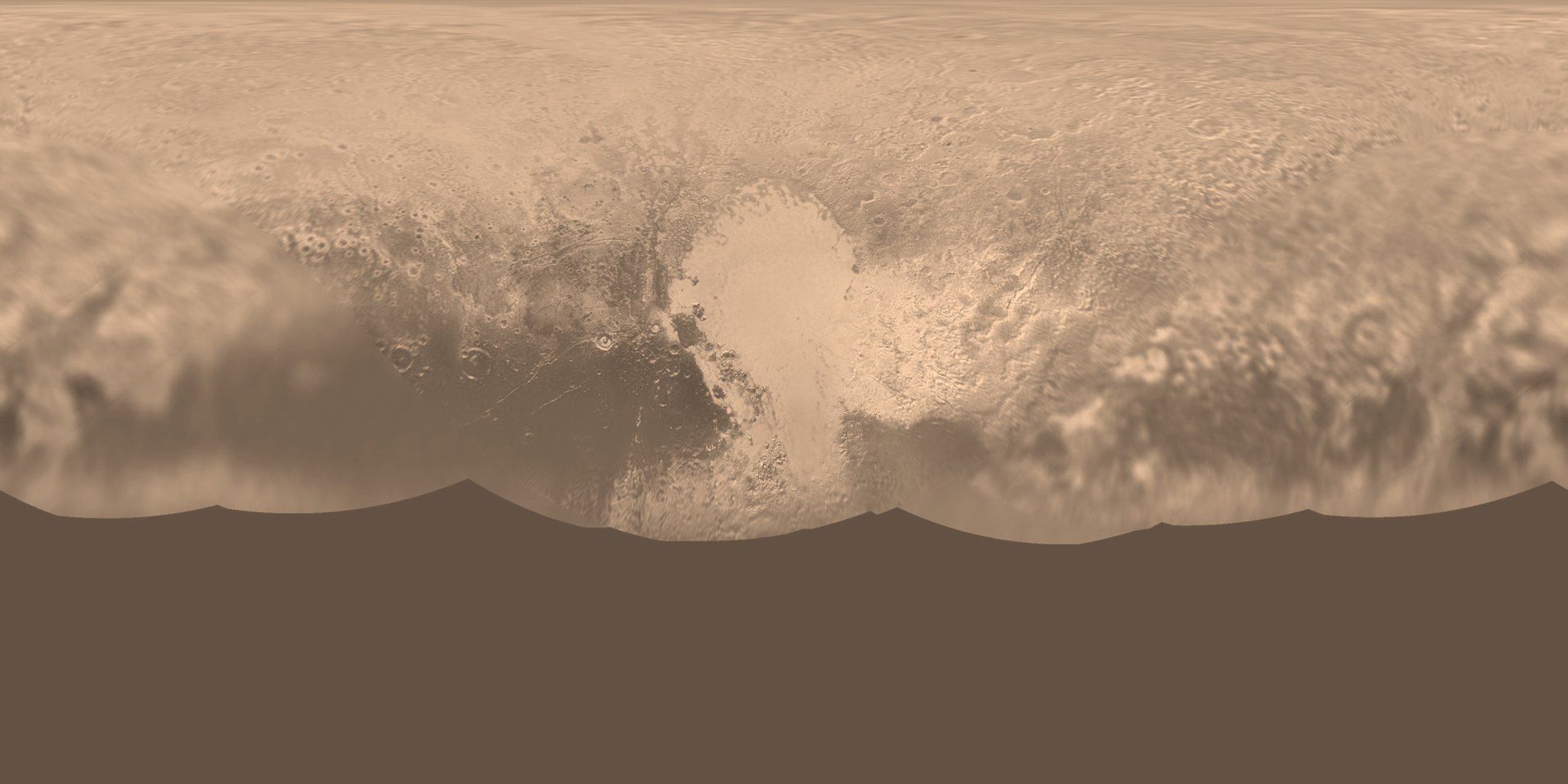
During its flyby in 2015 New Horizons saw only one side in sharp detail – the south and parts of the far side are blurred or missing (grey).
Seas and plains
- Sputnik Planitia
- The left half of Pluto's “heart”: a plain of nitrogen ice 1,000 km across. The ice slowly churns – as in a lava lamp – and forms giant cells.
Regions
- Tombaugh Regio (eastern part)
- The right half of the heart, named after Clyde Tombaugh, who discovered Pluto in 1930. Some of his ashes are travelling on board New Horizons.
- Cthulhu Macula
- A vast, dark, reddish-brown region – coloured by “tholins”, organic substances that form from methane under UV light.
- Lowell Regio
- The north polar region, named after Percival Lowell, who searched for a “Planet X” beyond Neptune.
Mountains and volcanoes
- Wright Mons
- A mountain around 4 km high with a deep depression on its summit – probably an ice volcano.
- Piccard Mons
- Another possible ice volcano, even bigger than Wright Mons (around 7 km high).
- Al-Idrisi Montes
- Mountains of giant, tilted blocks of water ice that “float” in the softer nitrogen ice.
In the 3D model you can click on these places on the map.
Moons of Pluto
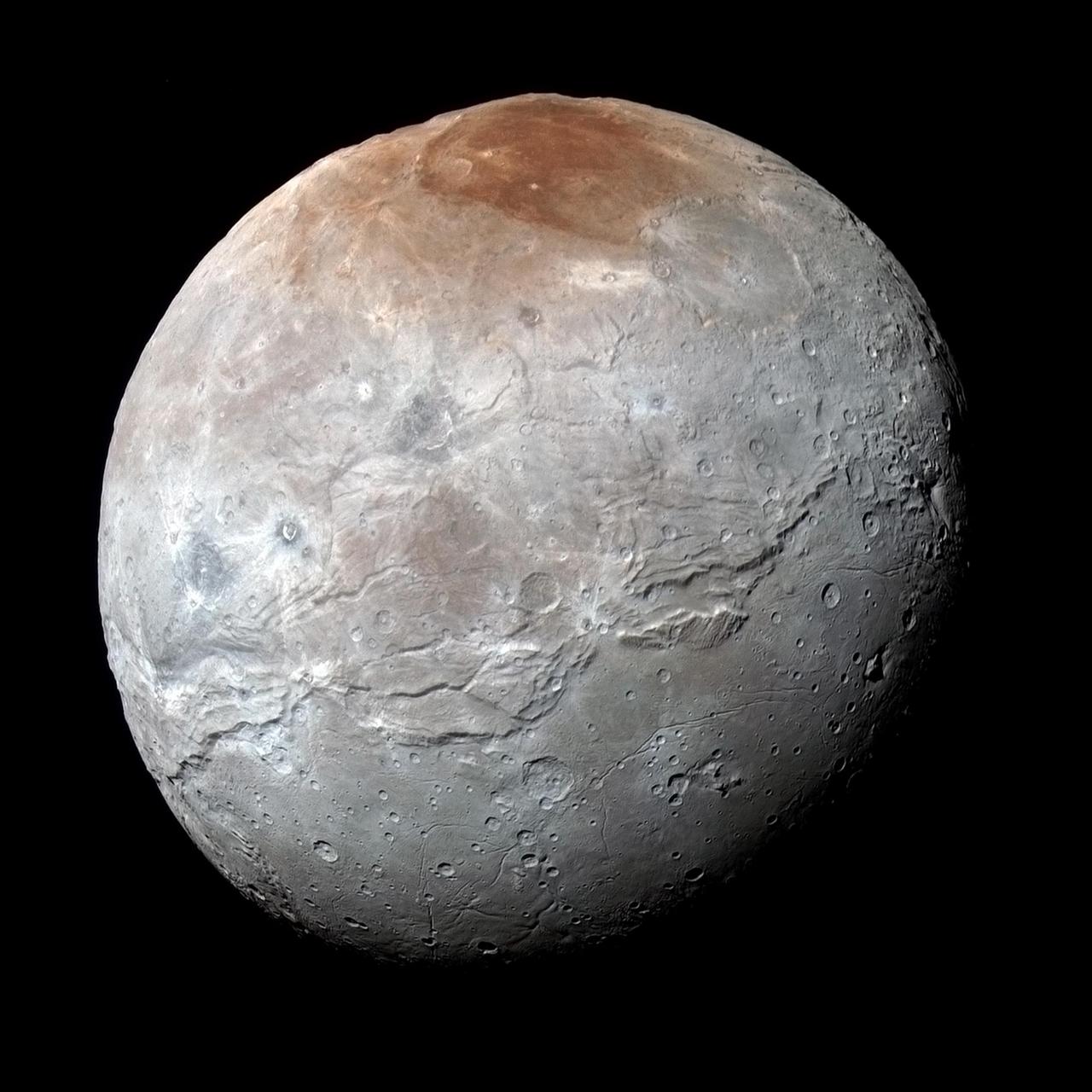 CharonCharon is half the size of Pluto – the two circle a shared point between them and almost count as a double …StyxStyx is the smallest of Pluto's five moons, only about 16 x 9 x 8 km in size.
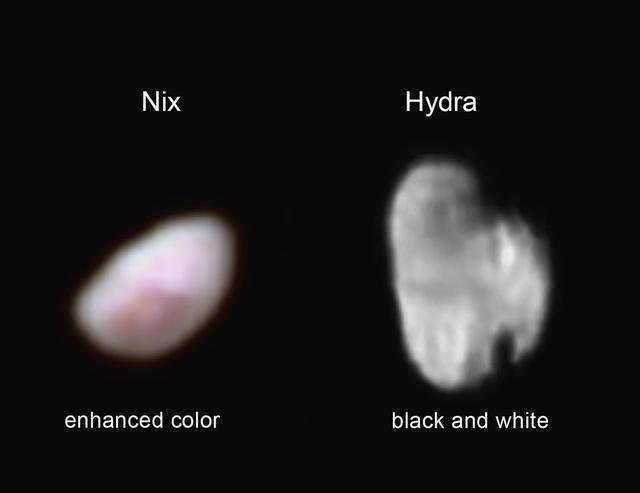 NixNix (around 50 x 35 x 33 km) tumbles chaotically – like all of Pluto's small moons, which are tugged to and …
 KerberosKerberos looks like two lumps stuck together (around 19 x 10 x 9 km).
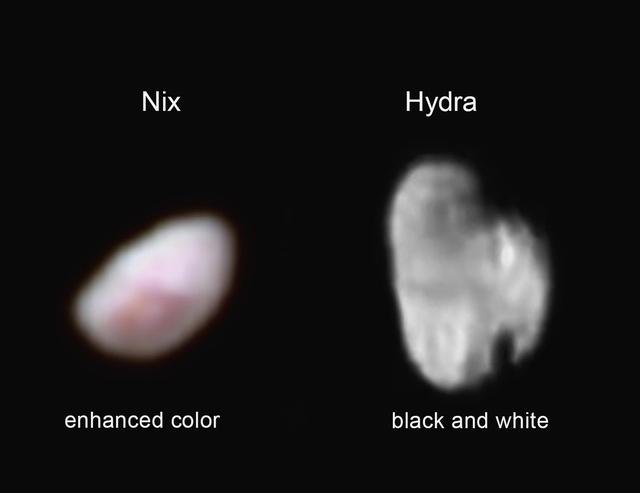 HydraHydra is Pluto's outermost moon (around 51 x 36 x 32 km).
Space probes at Pluto
Test your knowledge of Pluto
How many planets has our Solar System officially had since 2006?
8. In 2006 the International Astronomical Union reclassified Pluto as a dwarf planet.
What is the heart-shaped region on Pluto?
It is a vast ice field (Tombaugh Regio). In 2015 the New Horizons probe showed that the “heart” is made of nitrogen, methane and carbon monoxide ice.
Which probe flew past Pluto in 2015 and photographed its “heart”?
New Horizons. New Horizons travelled for more than 9 years and then flew on to the Kuiper Belt object Arrokoth.
The full quiz with points and badges is in the 3D model under “Explore”.
Pluto in the tours
This site is free and has no banner ads. Here is how you can support it