Home › Comets › 67P/Churyumov-Gerasimenko

Comet
67P/Churyumov-Gerasimenko
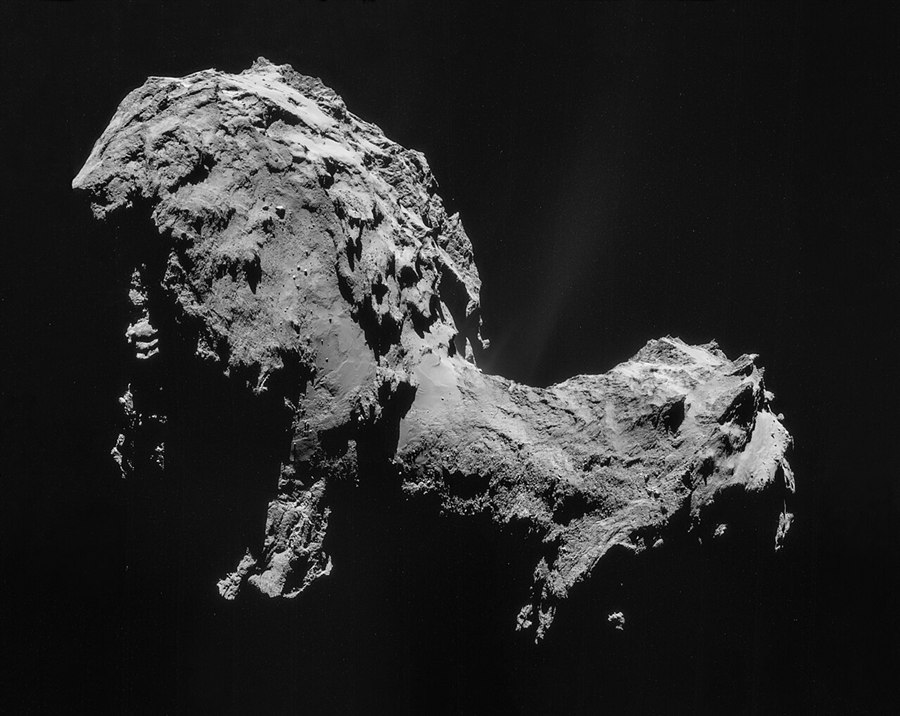
67P/Churyumov-Gerasimenko is a comet. It is about 4 km across – about as wide as Lake Zurich is long. In 2014 Philae landed on this comet – the first time ever that a probe had landed on a comet.
Fact file
- Type
- Comet
- Diameter of the nucleus
- 4.1 km
- Mean distance from the Sun
- 517,608,633 km
- Orbital period
- 6.4 years
- Shape of orbit (eccentricity)
- 0.641 – a very elongated ellipse
- Closest point to the Sun
- passed on 2 November 2021
Interesting facts about 67P/Churyumov-Gerasimenko
- In 2014 Philae landed on this comet – the first time ever that a probe had landed on a comet.
- It looks like a rubber duck – two lumps that gently bumped together.
- The European probe Rosetta accompanied it for two years on its way around the Sun.
Frequently asked questions about 67P/Churyumov-Gerasimenko
How long does 67P/Churyumov-Gerasimenko take to orbit the Sun?
67P/Churyumov-Gerasimenko orbits the Sun once in about 6.4 years.
Origin
A comet from the Kuiper Belt that Jupiter steered onto a short orbit. Discovered in 1969 by Klim Churyumov and Svetlana Gerasimenko.
Coma and tail
Rosetta found water with a different composition from that on Earth – so comets like this one probably did not bring Earth its water.
Exploration
Rosetta (ESA) reached the comet in 2014; Philae landed on 12 November 2014, bouncing twice as it did so. In 2016 Rosetta itself touched down gently.
Connection with Earth
The nucleus (about 4 km) would fit comfortably inside the city of Zurich – and has almost no gravity: a person would weigh only about one gram there.
Space probes at 67P/Churyumov-Gerasimenko
This site is free and has no banner ads. Here is how you can support it